Air Circulator Fan vs Electric Fan: Which to Buy? (November 2026)
Pick an air circulator if you want to move air across a whole room; pick a tower electric fan if you want a direct breeze where you sit or sleep. In an air circulator fan vs electric fan choice, the winner for most people is the circulator, because it cools more space with less noise.
On this page (10 sections)
- Air circulator fan vs electric fan: what is the real difference?
- The two side by side
- Which one cools a room faster?
- Which one is quieter at night?
- Which one suits a bedroom?
- Which one suits a living room or office?
- Which one is easier to set up and clean?
- Who should buy an air circulator?
- Who should buy a tower electric fan?
- Verdict: which fan should you buy?
Pick an air circulator if you want to move air across a whole room; pick a tower electric fan if you want a direct breeze where you sit or sleep. For most people, the circulator wins the air circulator fan vs electric fan decision, because it cools more of the room with less noise and takes up less space.
The Honeywell TurboForce Air Circulator is the best pick overall. It pushes 185 cfm of air up to 25 feet and its head pivots 90 degrees to aim the stream.
A tower electric fan like the DREO DR-HTF007 still makes sense when you want a tall, directed breeze and a remote in reach. This comparison breaks down where each type earns its place.

Air circulator fan vs electric fan: what is the real difference?
The difference is the shape of the airflow. A circulator is built to push a focused column of air across a room and keep it moving.
A standard electric fan, including a tower fan, is built to blow a wider, softer breeze straight at you.
That sounds small, but it changes how you use each one. A circulator works best when it aims along a wall or across the floor so the air loops around the room.
A tower fan works best pointed at the couch or the bed.
The design follows the job. Circulators have deep-pitched blades inside a housing that channels the air into a tight stream.
Tower fans use a tall, narrow column of blades and a wide outlet to spread air over a taller area.
The two side by side
The circulators here move more focused air per dollar of noise, while the tower fans offer more controls and a taller reach. Here is how the four models compare on the specs that decide the choice.
| Product | Best for | Airflow | Size (D x W x H) | Installation | Our score |
|---|---|---|---|---|---|
| Honeywell TurboForce Air Circulator | whole-room air movement | 185 cfm | 6.3 x 8.94 x 10.9 in | Tabletop or wall mount | 9.7 |
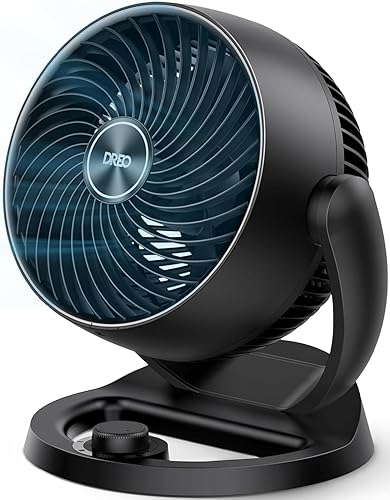
| DREO Fan for Bedroom | quiet bedrooms | 800 cfm | 10.79 x 10.08 x 14.21 in | Tabletop and wall mount | 9.6 |
| DREO 36-inch Tower Fan, 8 Speeds (DR-HTF007) | tower-fan buyers | 1158 cfm | 11.81 x 11.81 x 36.22 in | 8.1 | |
| Levoit 28ft/s Quiet Tower Fan | set-and-forget cooling | 1044 cfm | 6.5 x 6.5 x 36.2 in | 7.8 |
The Honeywell circulator moves 185 cfm and reaches 25 feet, and the DREO Fan for Bedroom pushes up to 70 feet at 25 dB. The DREO tower moves the most air on paper at 1158 cfm, but that figure reflects its wide oscillation and eight speeds.
Noise and control are where the types split most clearly. The circulators keep it simple with a knob or push buttons.
The tower fans add remotes, timers and auto modes.
Size and placement
The Honeywell measures about 6.3 x 8.94 x 10.9 inches and weighs 2.6 pounds. It sits on a desk, a shelf or a wall bracket, so it barely uses floor space.
The DREO Fan for Bedroom is bigger at about 10.8 x 9.5 x 11.8 inches and 5.5 pounds. It still works on a table or mounted on a wall.
The tower fans stand 36 inches tall. The DREO tower has a base of about 11.81 x 11.81 inches and the Levoit a slimmer 6.5 x 6.5 inches.
Both need floor space and clear room in front.
Airflow and coverage
The DREO Fan for Bedroom reaches up to 70 feet. That long throw is what lets a small circulator stir a whole room when it bounces air off walls.
The Honeywell reaches 25 feet. It suits small to medium rooms and close-range cooling, like a desk or a bedside.
The DREO tower projects up to 34 feet and oscillates 90 degrees. The Levoit tops out at 28 ft/s and uses a wide oscillation angle.
The tower fans cover a tall slice of the room rather than looping air around it.
Controls and quiet
The Honeywell has three speeds and push buttons. The DREO circulator has three speeds and a knob.
Neither adds a remote or timer.
The DREO tower gives you eight speeds, four modes and a remote plus touch panel. The Levoit offers five speeds, four modes and a remote, and its Auto mode changes speed as the room temperature shifts.
On noise, the DREO circulator runs as low as 25 dB. The Levoit tower runs at 28 dB on low.
The Honeywell's maker rates it 25% quieter than similar circulators.
Which one cools a room faster?
The circulator cools a room faster when you aim it to loop air around the space. A tower fan feels cooler sooner when it points straight at you, but it cools a smaller zone.
A fan does not lower the air temperature. What it does is move air across your skin, which speeds up sweat evaporation and makes you feel cooler.
That is why placement decides the winner. A circulator aimed at a wall or along the floor keeps the air in a room rotating.
A tower fan aimed at your chair gives you a direct stream and little else.
If you have an air conditioner, the circulator is the stronger partner. Point it across the room so the cold air from the AC spreads further.
The DREO circulator is the model to pick for this, since its 70-foot reach and 120 degree tilt let you aim the stream well.
Which one is quieter at night?
The DREO Fan for Bedroom is the quietest option here at 25 dB, so it wins for sleep. A tower fan can run quiet too, but its tall body and wider outlet make it harder to keep the noise low at useful speeds.
The DREO circulator combines NACA technology and a bionic blade design to move air efficiently while dropping noise to 25 dB. That is about the level of a soft whisper.
The Levoit tower gets down to 28 dB on its low setting and adds a 12-hour timer and a sleep mode. Its Auto mode also reacts to the room temperature, so it slows down as the night cools.
Pick the circulator if quiet matters most. Pick the Levoit tower if you want the fan to manage itself while you sleep and you don't mind a little more noise at higher speeds.
Which one suits a bedroom?
The circulator suits most bedrooms, because it moves air without a tall body crowding the room. The DREO circulator is the best bedroom pick, and the Levoit tower is the best tower for light sleepers.
A bedroom needs quiet air movement more than a strong blast. The DREO circulator's 25 dB low setting and its 120 degree tilt let you aim a soft stream at the bed or bounce it off the ceiling.
The Levoit tower brings a timer and auto mode to the bedroom. Its 12-hour timer means you can set it and forget it, and its temperature sensor slows the fan as the room cools.
It is 36 inches tall and 6.5 inches deep, so it tucks into a corner.
If you want to compare tower fans directly, our Dreo vs Lasko tower fan breakdown covers the trade-offs.
Which one suits a living room or office?
The tower fan suits a living room or office when you want a tall breeze and remote control from the couch or desk. The DREO tower is the better pick for shared spaces, thanks to its eight speeds and four modes.
Its 90 degree oscillation sweeps a wide slice of a room. The remote and touch panel let anyone in the room change the speed without leaving a seat.
The Honeywell circulator still has a place in an office. Its 90 degree pivoting head aims air at a desk from a shelf or wall mount, and it takes up almost no room.
That makes it the better desk companion if you want focused airflow and don't need a remote.
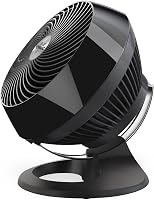
For a bigger, quieter floor circulator, read our Vornado 660 Large Air Circulator review to see how a full-size model compares.
Which one is easier to set up and clean?
Both types set up in minutes, and the tower fans here are the easier ones to clean. The DREO and Levoit towers both have removable grilles you can take off for a wipe-down.
The Honeywell circulator is simple to move and mount. It works on a tabletop or a wall, so you can lift it off a desk and set it up elsewhere in seconds.
The DREO circulator is the most flexible on placement. It works on a tabletop or a wall mount, has a handle and a base, and its parts come off for cleaning.
The tower fans take more floor space but less reaching. The DREO tower's rear grille and impeller come off, and the Levoit's back grille slides off for cleaning too.
The DREO tower adds a pinch-proof grille and a fused plug for safety.
Placement tips for each type
Aim a circulator along a wall or across the floor to keep air moving around the room. Point a tower fan at the spot where people sit, and set the oscillation to sweep the area.
Keep either fan out of a tight corner. A tower needs clearance in front for its airflow, and a circulator needs a clear path for its stream to travel.
Who should buy an air circulator?
Buy an air circulator if your main goal is to move air through a whole room quietly, or to stretch the reach of an air conditioner. The Honeywell TurboForce is the best value for small rooms, and the DREO Fan for Bedroom is the best for sleep.
Choose a circulator when:
- You want to spread cool air from an AC unit further.
- You need quiet airflow in a bedroom or home office.
- You are short on floor space and want a tabletop or wall-mount fan.
- You want to run a space heater or humidifier more efficiently in winter.
The circulator's focused stream does one thing very well: it keeps air in a room moving. If that matches your goal, it is the better fan type.
Who should buy a tower electric fan?
Buy a tower electric fan if you want a direct, adjustable breeze at head height and a remote you can use from the couch. The DREO DR-HTF007 is the best tower here, with eight speeds, four modes and a remote.
Choose a tower fan when:
- You want to aim a breeze at a sofa, bed or desk.
- You like having a remote, timer and auto mode.
- You have floor space in a corner and prefer a tall fan over a small one.
- You want more speed settings to fine-tune the airflow.
The Levoit tower is the better fit for a light sleeper who wants the fan to adjust to the room temperature. The DREO tower is the better all-rounder for a living room.
If a bladeless design appeals to you, our best bladeless fans guide covers those models and how they compare.
Verdict: which fan should you buy?
For most people, buy the Honeywell TurboForce Air Circulator. It wins this air circulator fan vs electric fan comparison because it moves 185 cfm of air up to 25 feet from a 2.6-pound frame, and its 90 degree pivoting head aims the stream where you need it.
The DREO Fan for Bedroom is the better circulator for a bedroom. Its 25 dB low setting and 70-foot reach make it the quietest way to stir a whole room.
Buy a tower electric fan only when a direct breeze and a remote matter more than room-wide coverage. The DREO DR-HTF007 is the best tower for a living room, and the Levoit tower is the best for set-and-forget night cooling.
One last check before you buy: decide whether you want to feel air on your skin or move the air in the whole room. That single question settles the choice.
If you are still weighing circulator sizes, our Vornado 630 vs 660 comparison shows how a smaller and larger model differ for the same room.
Frequently asked questions
Is an air circulator better than an electric fan for a bedroom?
An air circulator is the better bedroom pick when you want quiet, room-wide air movement; the DREO Fan for Bedroom runs at 25 dB. A tower electric fan is better if you want a direct breeze aimed at the bed and a remote in reach.
Do air circulators actually cool a room?
No fan lowers the air temperature on its own. A circulator moves air faster across the whole room, which helps sweat evaporate so you feel cooler and spreads air-conditioned air further.
A tower fan does the same thing in a narrower, more direct stream.
Can I use an air circulator with an air conditioner?
Yes, and it is one of the best ways to use one. Aim the circulator across the room so it pushes the cold air away from the AC unit and around the space.
That lets you raise the thermostat a little and still feel comfortable.
Which fan type is quieter, a circulator or a tower fan?
It depends on the model, not the type. A quiet circulator like the DREO runs at 25 dB, while the Levoit tower drops to 28 dB on low.
Both makers publish noise figures, so compare the low-speed number for the models you are considering.
How much floor space does a tower fan need compared with a circulator?
A circulator takes up far less. The Honeywell tabletop model measures about 6.3 x 8.94 inches at its base, while the DREO tower is roughly 11.81 x 11.81 inches and stands 36 inches tall.
A tower fan also needs clear space in front for its airflow.