8 Best Bladeless Fans (October 2026)
The best bladeless tower fans include the Shark TurboBlade Bladeless Tower Fan (TF202) for shared rooms, the dreame MF10 Bladeless Tower Fan for app control, and the PELONIS 40-inch Bladeless DC Tower Fan for light sleepers.
On this page (8 sections)
- How we chose the best bladeless fan
- Compare the best bladeless fans
- Best bladeless fans for different rooms and routines
- How do you choose the best bladeless fan for your room?
- How do you set up and use a bladeless fan?
- How should you clean and care for a bladeless fan?
- What mistakes should you avoid when buying a bladeless fan?
- Which bladeless fan should you buy?
The best bladeless fan for flexible airflow is the Shark TurboBlade Bladeless Tower Fan (TF202), with pivoting positions, twistable vents and up to 180° oscillation. The dreame MF10 is a strong choice for app and voice controls, while PELONIS offers options for quiet operation and smart home use.
A bladeless design can be easier to wipe around than exposed fan blades, but airflow, controls and maintenance still vary. This guide compares the best bladeless fan choices by room coverage, nighttime use, controls and care.
Our picks at a glance
-
1
 Best for shared rooms
Shark TurboBlade Bladeless Tower Fan (TF202)
8.9/10 our score
See it on Amazon -
2
-
3

- 4
 Check it
PELONIS Smart Bladeless Tower Fan
Best for voice assistants - 5
 Check it
DREO Bladeless Tower Fan, 25ft/s
Best for room-to-room moves - 6
 Check it
PELONIS 40-inch Bladeless Tower Fan with Remote
Best for long schedules - 7
 Check it
Antarctic Star T42 Bladeless Tower Fan
Best for taller placement - 8
 Check it
Antarctic Star T36 Bladeless Tower Fan
Best for low shelves
How we chose the best bladeless fan
The best bladeless fan for you depends on where air needs to go, how you control the fan and how you plan to clean it. We compared airflow features, oscillation, modes, height and cleaning access.
A broad sweep can cover more of a shared room, while a shorter tower may fit better beside furniture. App or voice support matters if you want to change settings without reaching the control panel.
Noise figures are stated for some models, but a single number can't tell you how a fan will sound at every speed or in every room. Consider low speed options, sleep modes and display behavior along with any stated decibel number.
A fan moves air but doesn't lower the room's air temperature like an air conditioner. If you're deciding between fan types, our room fan cooling guide explains how tower fans, circulators and other designs differ.
Compare the best bladeless fans
The main differences are airflow direction, controls and cleaning access. Use the table to narrow the choices before reading each pick's details.
| Product | Best for | Airflow coverage | Controls | Cleaning | Our score |
|---|---|---|---|---|---|
| Shark TurboBlade Bladeless Tower Fan (TF202) | shared rooms | Up to 180° oscillation; adjustable direction | Remote included | Wipe-clean bladeless design | 8.9 |
| dreame MF10 Bladeless Tower Fan | app control | Up to 270° | App, voice assistance and remote | Removable, washable primary filter | 8.5 |
| PELONIS 40-inch Bladeless DC Tower Fan | light sleepers | Remote | 8.1 | ||
| PELONIS Smart Bladeless Tower Fan | voice assistants | Touch, app and voice control | 7.7 | ||
| DREO Bladeless Tower Fan, 25ft/s | room-to-room moves | Panel and remote | 7.5 | ||
| PELONIS 40-inch Bladeless Tower Fan with Remote | long schedules | Remote and touch panel | 7.4 | ||
| Antarctic Star T42 Bladeless Tower Fan | taller placement | Touch and remote | 7.0 | ||
| Antarctic Star T36 Bladeless Tower Fan | low shelves | Touch and remote | 6.9 |
Best bladeless fans for different rooms and routines
These picks are ordered by score, with the top spot going to the model that offers the most flexible ways to direct airflow. Each alternative suits a distinct room or control preference.
Shark TurboBlade Bladeless Tower Fan (TF202): Best for shared rooms
- Pivots vertically and horizontally
- Twistable vents
- Up to 180° oscillation
- 10 speeds and noise levels
Pivoting airflow, twistable vents and adjustable height make this the most adaptable pick for directing air around a room.
Pros
- Multiple airflow positions
- 10 speeds
- Remote included
Cons
- No app control
- Larger footprint than a compact tower fan
The Shark TurboBlade Bladeless Tower Fan (TF202) stands out for adjustable airflow direction. It can pivot from vertical tower airflow to a horizontal air blanket, while twistable vents and up to 180° oscillation give you more ways to direct air across a room.
Its height adjusts, and 10 speeds let you choose between gentler airflow and stronger movement. Shark describes 10 noise levels, so you can match the fan's sound profile to your activity.
The wipe-clean bladeless design and Dust Defense feature are aimed at easier upkeep. A remote is included, which lets you adjust the fan without walking to its controls.
Choose it when you want one fan to serve different positions or parts of a shared room. Skip it if you need app control, or if its larger footprint is hard to fit beside your furniture.
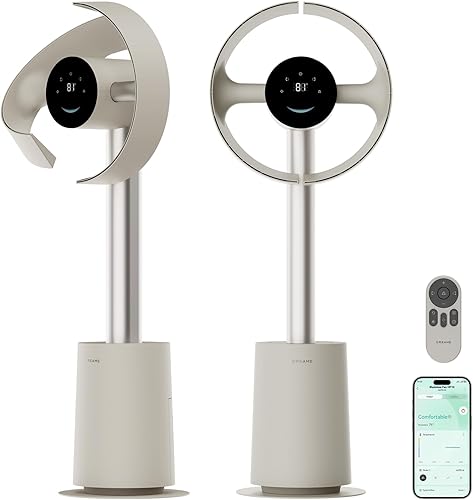
dreame MF10 Bladeless Tower Fan: Best for app control
- Up to 270° airflow coverage
- App and voice controls
- Temperature sensor
- Washable primary filter
App and voice control pair with temperature-based adjustment and a washable intake filter for buyers who want more automation.
Pros
- Wide stated airflow coverage
- Multiple control methods
- Washable primary filter
Cons
- Temperature display is in Fahrenheit only
- Only 3 speeds
The dreame MF10 Bladeless Tower Fan suits buyers who want app and voice control alongside broad airflow coverage. Its GyroWing system is described as providing up to 270° coverage, with two sections that rotate vertically.
A built-in temperature sensor supports automatic airflow adjustment as room conditions change. App control, voice assistance and a magnetic remote give you several ways to manage settings.
The removable primary filter captures larger particles such as hair and dirt, and it can be washed and reused. The display temperature is in Fahrenheit only, and the fan has three speeds, so skip this model if you need Celsius readings or many manual speed steps.
Choose it when you want automation and multiple control options in one freestanding tower. If you want a simpler way to size airflow to your room, read what size fan you need for your room.
PELONIS 40-inch Bladeless DC Tower Fan: Best for light sleepers
- DC motor
- 6 speeds and 4 modes
- 90° oscillation
- Remote included
This 40-inch model combines a DC motor, six speeds and four modes with remote control for flexible everyday use.
Pros
- Six speeds and four modes
- DC motor
- Remote included
Cons
- No smart app control
- Timer is 7 hours
The PELONIS 40-inch Bladeless DC Tower Fan is a fit for buyers who prioritize quiet airflow with straightforward remote control. It has six speeds, four modes and 90° oscillation, giving you several settings without requiring an app.
PELONIS gives a stated noise level of 22 dB and a DC motor. A seven-hour timer supports scheduled operation, while the 40-inch height suits a floor-standing setup.
Choose this model if you want a remote, several modes and a stated low noise level for a bedroom or home office. Skip it if you want app or voice control, or need a timer longer than seven hours.
Read our DC fan vs AC fan guide if motor choice is part of your decision.
PELONIS Smart Bladeless Tower Fan: Best for voice assistants
- Alexa and Google compatibility
- 6 speeds
- 120° oscillation
- 7-hour timer
Smart home support makes this PELONIS a fit for buyers who want to adjust airflow through an app or voice assistant.
Pros
- Alexa and Google compatibility
- 120° oscillation
- Plug-and-play setup
Cons
- Six speed settings
- Timer is 7 hours
The PELONIS Smart Bladeless Tower Fan suits buyers who want voice assistant support. It works with Alexa and Google Assistant, and you can also manage it through an app.
The model has six speeds, 120° oscillation and a seven-hour timer. Touch controls provide another way to change settings when your phone or voice assistant isn't convenient.
Choose this fan if you already use a supported voice assistant and want remote adjustment from your phone. Skip it if you want to avoid app setup or prefer a listed cleaning feature such as a removable grille or washable filter.
For general maintenance advice, our guide to cleaning a Vornado fan covers safe habits that also apply to many floor fans.
DREO Bladeless Tower Fan, 25ft/s: Best for room-to-room moves
- 36-inch body
- Up to 25 ft/s airflow
- 4 speeds and 4 modes
- Removable rear grille
A 36-inch body, hidden handle and removable rear grille suit buyers who want a tower fan that is easier to move and clean.
Pros
- Hidden carry handle
- Four modes
- Removable rear grille and impeller wheel
Cons
- No app control
- 90° oscillation
The DREO Bladeless Tower Fan, 25ft/s suits buyers who move a fan between rooms. A hidden handle helps you carry it, and the rear grille and impeller wheel can be removed for cleaning.
Four speeds and four modes offer a range from sleep airflow to stronger settings. It also oscillates through 90°, and the included remote stores in a built-in compartment.
Choose it if room-to-room moves and access for cleaning matter more than smart control. Skip it if you need app support or a broad sweep beyond its 90° oscillation.
For placement ideas that can improve airflow, read how to cool a room with a fan.
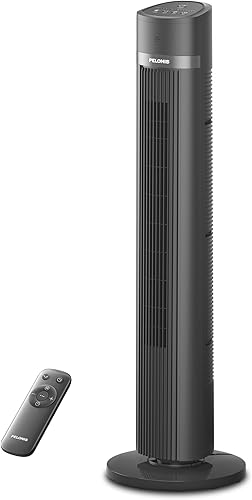
PELONIS 40-inch Bladeless Tower Fan with Remote: Best for long schedules
- 40-inch tower
- Remote included
- Temperature-responsive airflow
- 15-hour timer
Remote control, temperature-responsive airflow and a 15-hour timer make this a practical option for scheduled cooling.
Pros
- Remote included
- 15-hour timer
- Three speed settings
Cons
- No app control
- Mode and speed details vary across the description
The PELONIS 40-inch Bladeless Tower Fan with Remote is best for scheduled airflow over longer periods. Its 15-hour timer is the longest stated timer among these picks.
It includes a remote and touch panel, plus three speed settings and multiple modes. PELONIS says its Sensi Cool Algorithm adjusts airflow based on room temperature.
The product has differing mode and speed counts across its descriptions, so confirm that the controls meet your needs before you choose it. Its stated airflow capacity is 1200 CFM, and it stands 39.88 inches tall.
Choose this model when the longer timer and remote matter most. Skip it if precise speed and mode counts are important to your decision, or if you need app control.
Antarctic Star T42 Bladeless Tower Fan: Best for taller placement
- 42-inch height
- 6 speeds and 4 modes
- Removable rear grille
- Child lock
The taller 42-inch tower has six speeds, four modes and a removable rear grille for buyers who value cleaning access.
Pros
- Tallest model in this group
- Removable rear grille
- Child lock and screen auto-off
Cons
- No app control
- Remote storage is on the back
The Antarctic Star T42 Bladeless Tower Fan suits buyers who want a taller tower with cleaning access. It has six speeds, four modes and a removable rear grille that snaps off without tools.
Touch controls and a remote let you adjust settings from nearby or across the room. It also has a child lock and a display that dims automatically after use.
Choose it if its 42-inch height fits your room and you want to remove the grille for deeper cleaning. Skip it if app control matters or you want remote storage somewhere other than the back of the fan.
The shorter T36 keeps many of the same controls in a lower tower.
Antarctic Star T36 Bladeless Tower Fan: Best for low shelves
- 36-inch height
- 6 speeds and 4 modes
- Removable rear grille
- Child lock
This shorter Antarctic Star keeps the six-speed controls and removable rear grille of the T42 in a lower tower.
Pros
- Shorter height
- Removable rear grille
- Child lock and screen auto-off
Cons
- No app control
- Same stated airflow capacity as the T42
The Antarctic Star T36 Bladeless Tower Fan suits rooms where a shorter tower is easier to place. It shares the T42's six speeds, four modes and removable rear grille.
The remote and touch controls make adjustment straightforward, while child lock and automatic screen dimming help reduce unwanted changes and light at night. Its stated noise level is 22 dB.
Choose the T36 where a lower profile works better; choose the T42 if a taller fan better suits your placement. Both have the same stated airflow capacity, so height is the clearest difference between them.
How do you choose the best bladeless fan for your room?
Choose a bladeless fan by matching its airflow pattern and controls to where you sit, sleep or work. Then check dimensions, timer and cleaning access before deciding.
- Map the airflow path: Note where you want air to reach and whether a fixed direction or oscillation fits. The Shark pivots and directs air in different orientations; dreame describes up to 270° coverage.
- Measure the floor space: Compare the fan's height and base dimensions with the spot beside a bed, sofa or desk. Leave room to reach controls and move around it.
- Choose controls you will use: A remote works without a phone setup. App and voice control can help when the fan is across the room, but only if you want to configure those options.
- Match settings to your routine: More speeds let you make smaller adjustments. A timer can shut the fan off after you fall asleep or leave the room, so choose a duration that fits your schedule.
- Plan for cleaning: A smooth surface can be quick to wipe. A removable grille or washable intake filter provides different access for dust and hair, so consider which maintenance task you prefer.
- Treat sound numbers as one clue: Decibel figures and sleep modes can help narrow choices, but fan position, speed and room acoustics also affect what you hear.
A fan can help circulate air, but it won't lower the room's temperature by itself. For placement and direction tips, see our guide to fan direction for cooling a room.
How do you set up and use a bladeless fan?
Set up a bladeless fan on a stable, level floor with its air intake clear of walls, curtains and furniture. Assemble any base parts according to the manual, then choose a low setting and check that the airflow reaches the place you want.
Place the fan where its oscillation path won't blow directly into an obstruction. Keep cords out of walking paths, and avoid covering the intake or outlet with fabric, dust covers or nearby objects.
If the fan has a remote, keep it in its holder or a consistent nearby spot. For app or voice models, complete the connection steps in the manufacturer's instructions before relying on remote access.
Start with a lower speed and adjust after you feel the airflow from your normal seat or bed position. Stronger airflow is not automatically better if it feels distracting or points away from the area you want to cool.
How should you clean and care for a bladeless fan?
Clean a bladeless fan with the power unplugged, using the method allowed by its manual. Wipe accessible exterior surfaces with a soft cloth, and clean removable grilles or filters only as directed for that model.
The Shark has a wipe-clean design, the dreame MF10 has a washable primary filter, and the DREO and Antarctic Star picks have removable rear grilles. These are different maintenance approaches, so don't assume one fan's parts or cleaning steps apply to another.
Let a washable filter dry fully before reinstalling it, if the manual permits washing. Avoid spraying liquid into openings, forcing parts off, or reaching inside the housing where moving components may sit.
Check the intake and outlet from time to time for visible dust or hair. A clear airflow path helps the fan move air as intended and makes it easier to spot when normal surface cleaning is due.
What mistakes should you avoid when buying a bladeless fan?
The most common buying mistake is choosing by a single headline number instead of checking how the fan fits your room and routine. A wide stated coverage angle, low noise figure or high airflow claim doesn't answer every placement and control question.
- Don't treat a fan as an air conditioner: A fan moves air and can make you feel cooler, but it doesn't lower room temperature.
- Don't assume all bladeless designs clean the same way: Some are made to wipe clean; others have a removable grille or filter. Check the method that fits your comfort with upkeep.
- Don't buy more controls than you will use: App and voice support add options, but a remote or touch panel may be enough for a fan that stays in one place.
- Don't overlook timer length: A seven-hour timer may suit an evening routine, while a longer schedule may call for the PELONIS model with a 15-hour timer.
- Don't compare noise figures without context: Check which features matter at low speed, including sleep mode and display behavior, and consider where the fan will stand.
- Don't skip measurements: A taller tower or wide base can be awkward beside furniture even if its airflow features look appealing.
Which bladeless fan should you buy?
Choose the Shark TurboBlade if you want the most ways to point airflow around a shared room. Pick the dreame MF10 for app and voice control with a washable intake filter, or the PELONIS DC tower if a quiet-focused bedroom setup and remote operation matter most.
Choose the PELONIS Smart model for Alexa or Google support, the DREO 307 if you move the fan between rooms, and the 15-hour PELONIS if long scheduled operation is the priority. Select the Antarctic Star T42 for a taller tower with a removable grille, or the T36 when a shorter body fits better.
If none of these airflow patterns fit your room, compare other Vornado fans by room size and use our guide to fan direction for cooling a room to plan placement.
Our top 3 picks at a glance
-
1
Best for shared rooms
Shark TurboBlade Bladeless Tower Fan (TF202)
8.9/10 our score
See it on Amazon -
2
-
3
Frequently asked questions
What is a bladeless fan?
A bladeless fan uses an internal motor to draw in air and send it through an outlet or loop-shaped head, so you don't see exposed fan blades. The models here are tower fans with different airflow patterns, controls and cleaning features.
Check the specific design before buying, since “bladeless” doesn't mean the fan has no moving parts inside.
Do bladeless fans cool a room?
Bladeless fans move air across your skin, which can make you feel cooler, but they don't lower the room's air temperature like an air conditioner. Direction and coverage matter, so pick a model that can move air where you sit or sleep.
For more room-by-room options, see our plain guide to room fans.
Are bladeless fans easier to clean?
They can be easier to wipe because they don't have exposed blades, but cleaning access differs by model. Shark describes its TurboBlade as wipe-clean, while the DREO and Antarctic Star models have removable rear grilles.
Follow the manual for safe cleaning, and unplug the fan first.
Are bladeless fans quiet enough for a bedroom?
Some models state low noise levels or include sleep modes, but perceived sound depends on speed and room conditions. The PELONIS DC tower and Antarctic Star models state 22 dB, while DREO lists 34 dB.
If nighttime noise is a priority, compare low-speed settings and display controls before choosing.
How should I choose a bladeless fan for my room?
Start with the airflow direction and coverage you need, then check height, controls, timer and cleaning access. A wider oscillation range may suit a shared room, while app control can help if you adjust the fan remotely.
Use our room fan cooling guide and fan size guide to narrow the fit.