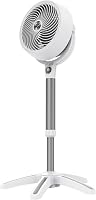
What Size Fan Do I Need for My Room?
For what size fan you need for your room, start with the area, layout and spot where you want air to reach. Choose focused airflow for a nearby bed or desk, and broader circulation for a larger or open room.
On this page (9 sections)
- What size fan do I need for my room area?
- How should you measure the room before choosing?
- What fan works well for a bedroom?
- What fan should you choose for a living room?
- Should you choose airflow, fan height or oscillation?
- When do you need more than one fan?
- How should you set up and place the fan?
- How do you care for a room fan?
- Which fan size should you pick?
For what size fan do I need for my room, start with the room’s area, layout and where you want the air to go. A bedroom fan may need to reach a bed, while a large living room may call for broader circulation or separate fans for distinct zones.
Room area is a useful starting point, but it cannot tell you exactly how airflow will feel. Ceiling height, furniture, open doorways and distance from the fan all affect how air reaches you.
If you’re comparing fan styles first, see our guide to room fans for cooling. This guide helps you match a fan’s airflow and placement to your space.
What size fan do I need for my room area?
Choose a fan that moves air across the part of the room where people spend time. A small fan may be enough for a nearby seat or bed, while a large or open room often needs broader circulation.
There isn’t one fan diameter or airflow number that fits every room of a given size. Use the table as a starting point, then account for the room’s shape and use.
| Room situation | Start by looking for | Check before choosing |
|---|---|---|
| Small bedroom or home office | Focused airflow near the bed or desk | Fan noise, tilt and distance to your seat |
| Medium bedroom or living room | Airflow that reaches beyond one spot | Whether the fan oscillates or can be aimed |
| Large living room | Stronger or broader room circulation | Furniture, long distances and separate seating zones |
| Open-plan area | Airflow positioned for the main occupied zone | Whether walls or furniture block the path |
| High bed or raised seating | Airflow that reaches the height you need | Fan height, tilt and where it will stand |
These are shopping cues, not fixed room-size limits. A high ceiling or long, narrow shape can leave a fan placed in one corner short of the area you care about.
What fan size should you choose for a small or large room?
For a small room, prioritize placement and a manageable footprint; for a large room, look for a fan that can move air farther or across a broader zone. The right choice depends on whether you want a breeze at one spot or circulation across an occupied area.
A published room-area recommendation can help you compare candidates when the brand provides one. Still, look at how the fan’s airflow, height and direction fit your room rather than treating a square-foot figure as a guarantee.
How should you measure the room before choosing?
Measure the length and width of the usable area, then note ceiling height and the main places where you sit, work or sleep. The area describes the space, while those locations show where the fan needs to send air.
Multiply room length by width to get the floor area in square feet. For example, a room that is 12 ft by 14 ft has 168 sq ft of floor area.
Use that number to compare your space with a fan’s published room-size guidance, if available. Then consider whether the airflow can reach your usual spot.
Also note details that change the airflow path:
- High ceilings leave more vertical space above the area where you want a breeze.
- Long or L-shaped rooms may put seating far from the fan.
- Large furniture can block a direct path.
- Open doorways connect the room to another space.
- Multiple seating areas may need airflow from different directions.
Measure the spot where a fan will stand, too. Check the base or footprint against walkways, furniture and outlets, and make sure it can point toward your target area.
What fan works well for a bedroom?
For a bedroom, choose a fan that sends airflow toward the bed without taking up more floor space than you have. Height, tilt, oscillation and noise information can matter as much as the room’s floor area.
A direct breeze may suit you if you sleep close to the fan. If you want airflow across more of the room, consider a fan that oscillates or circulates air beyond one fixed point.
The Levoit adjusts from 36 to 47 in tall and converts to a 24 in fan. Its 90-degree oscillation and remote can help when you want adjustable height and airflow near a bed.
Check noise information if sound matters while you sleep. The published noise level is one reference point, and your distance from the fan and the room itself affect what you hear.
For more bedroom-specific options, see our guide to quiet tower fans for sleeping and reading. You can also read about cooling a room with a fan for placement ideas.
What fan should you choose for a living room?
For a living room, choose based on the seating area you want to reach and how far the air must travel. One chair and a wide open room need different airflow patterns.
A floor circulator can work when you can aim air through a clear path. The Vornado 660 has adjustable tilt and is designed to move air up to 100 ft; the Vornado 630 also has a tilt head for directing airflow.
For several seats spread across a wider area, a pedestal fan may be easier to aim and move around. The DREO pedestal fan oscillates horizontally and vertically and is designed for spaces up to 105 sq ft.
For more options by room type, see standing fans for living rooms and fans for large rooms and open floor plans.
Should you choose airflow, fan height or oscillation?
Choose airflow first when the room is large, height when air needs to reach a raised bed or seat, and oscillation when you want a breeze to cover a wider area. Each feature solves a different placement problem, so focus on the one your room creates.
Airflow figures help you compare models, but they do not guarantee how air will feel in your room. A fan aimed at a wall or blocked by furniture may be less useful than a smaller fan with a clear path.
Height matters when the target is above the fan. A low fan that cannot reach a high bed or chair may leave you repositioning it often.
Oscillation spreads airflow over a broader area, but it does not mean every part of a room receives the same breeze. Check the fan’s stated range and consider where people sit most often.
For air to reach around a corner, compare more than the fan’s reach. Place it where airflow has the clearest route, then adjust its tilt or direction.
Which fan features matter for your room size?
For room-size decisions, compare the airflow path, the fan’s height or tilt, and whether it oscillates. Controls and modes can make regular adjustments easier, but they do not make a blocked airflow path useful.
The Vornado 660 has 4 speeds and top-mounted push-button controls, while the Vornado 630 has 3 speeds and a control dial. The Levoit offers 5 speeds, 4 modes and a remote; the DREO offers 9 speeds, 6 modes and app, voice and remote controls.
Those choices suit different routines. Pick simple manual controls if you prefer to change the fan at the unit, or a remote and app if you want to adjust settings from elsewhere in the room.
When do you need more than one fan?
Use more than one fan when a single position cannot serve separate parts of the room. This often happens in open-plan layouts, long rooms or spaces where furniture blocks airflow.
Start by identifying the places where people spend time. If the seating area and work area are far apart, two fans aimed at those zones may work better than one fan pointed between them.
Try moving one fan before adding another. A position closer to the occupied area or near a doorway may create a clearer airflow path.
Two fans take up more floor space and need suitable outlets. Keep cords out of walkways and place each fan where airflow can reach people without blowing into an obstruction.
How should you set up and place the fan?
Place the fan where it has a clear route to the people or area you want to reach. Aim it toward a bed, desk or seating area, then adjust its direction and speed to suit the space.
A floor circulator with a tilt head can point airflow higher or lower. An oscillating fan can sweep across a wider area, but make sure it has room to turn without facing a wall or large obstacle.
If you want air to travel through a room, place the fan so the airflow can move along the space rather than stopping at a sofa or cabinet. For more help with placement and direction, read which way a fan should face to cool a room.
Set the fan on a stable, level surface and keep items clear of its intake and outlet. Follow the fan’s safety and placement instructions, and check that cords will not cross a walkway.
What mistakes make a room fan less useful?
The most common mistake is choosing by room area alone and ignoring where people sit or sleep. A fan can have suitable airflow and still miss the target if it points toward a wall, sits behind furniture or is too low for a raised bed.
Another mistake is expecting oscillation to fix every layout problem. It spreads the breeze across a set range, but cannot direct air through solid obstacles or around a sharp corner.
Avoid placing the fan where its base blocks a walkway or its cord creates a trip hazard. Before buying, check both the fan’s footprint and the available outlet position.
How do you care for a room fan?
Keep the airflow path clear and clean the fan according to its care instructions. Dust on the intake or grille can collect over time and make routine upkeep harder.
Unplug the fan before cleaning it. Use the maker’s instructions to learn which parts can be removed and which surfaces should be wiped, and do not force a grille or housing open.
A tower fan can have a narrow grille and a circulator can have a removable grille, so the cleaning approach varies by design. See our guides to cleaning a tower fan without disassembly and cleaning a floor fan for more specific steps.
Which fan size should you pick?
Pick the fan that matches your main use and the room’s airflow path. For a nearby bed or desk, prioritize easy aiming and suitable noise details; for a large living room, look for broader circulation or plan separate zones.
Choose the Levoit if you need height options near a high bed. Choose the DREO if airflow needs to sweep across several spots, or a tilt-adjustable Vornado circulator if you can aim it through the room.
For open layouts or long rooms, map the seating areas and clear paths before choosing. If one fan may not serve the whole space, compare our large-room fan guide before deciding.
Frequently asked questions
What size fan do I need for a small bedroom?
For a small bedroom, choose a fan that can reach the bed or desk without crowding the floor. A compact circulator can aim a direct breeze, while an oscillating fan can spread airflow across more than one spot.
Check the fan’s height, noise information, controls and the distance from its planned position to your bed.
What size fan do I need for a large living room?
For a large living room, start with the seating area and the distance air must travel. A circulator with a clear path can serve one zone, while a pedestal fan with oscillation can sweep across several nearby seats.
If furniture, corners or separate zones interrupt the path, plan a second fan or compare fans made for larger rooms.
Does a bigger fan cool a room better?
A bigger fan does not automatically cool a room better. The airflow pattern, distance, obstacles and where people sit all affect how useful it feels.
Choose a fan that can move air along a clear path to your usual spot, then adjust its direction and speed for the room.
How do I choose a fan for a high bed?
For a high bed, choose a fan that can send air to mattress height. An adjustable pedestal or tower fan may make that easier because you can change its height or aim.
Measure the bed and the planned fan position, then check that the airflow can reach you without pointing into a wall or obstruction.
Can one fan cover an open-plan room?
One fan can serve an open-plan room when it has a clear path to the area people use most. Furniture, walls and separate seating zones can interrupt airflow across the space.
Place the fan for the main occupied area.
Add a second fan if another zone needs its own breeze and one position cannot serve both.