8 Best Fans for Large Rooms and Open Floor Plans (October 2026)
The best fans for large rooms and open floor plans include the DREO Smart Tower Fan for app-controlled rooms, the DREO 100ft Airflow DC Pedestal Fan for adjustable seating, and the Vornado 660 Large Air Circulator for focused circulation.
On this page (8 sections)
- How we chose the best fan for a large room
- Which best fan for large room fits your layout?
- How should you choose a fan for an open floor plan?
- How do airflow, oscillation, and fan shape affect a large room?
- How do you place and set up a large-room fan?
- How can you keep a large-room fan working well?
- What mistakes should you avoid when buying a fan for a large room?
- Which fan is best for a large room?
The best fan for a large room depends on the airflow pattern you need, the room’s shape, and where people sit. The iLiving has the highest stated airflow in this group, while the Vornado 660 is compact and directional and the DREO pedestal fan offers height adjustment and oscillation.
A fan moves air across occupied areas, but it doesn't lower the room's temperature. In an open floor plan, aim airflow along a clear route and consider whether one fan can reach the seating areas you use most.
For an overview of fan styles, start with room fans for cooling. If you're deciding between a tower and a floor fan, see our tower fan vs floor fan comparison.
Our picks at a glance
-
1
 Best for app-controlled rooms
DREO Smart Tower Fan, 120-Degree Oscillation
9.0/10 our score
See it on Amazon -
2

-
3
 Best for focused circulation
Vornado 660 Large Air Circulator, Black
9.0/10 our score
See it on Amazon
- 4
 Check it
Lasko Wind Machine 3301 20-inch Floor Fan
Best for targeted airflow - 5
 Check it
Vornado 753 OSC Oscillating Air Circulator
Best for shared seating - 6
 Check it
DREO Smart Tower Fan, 40 to 45-inch Adjustable
Best for changing airflow height - 7
 Check it
iLiving 30-inch Commercial Pedestal Fan
Best for industrial spaces - 8
 Best for quiet roomsCheck it
How we chose the best fan for a large room
We compared stated airflow, direction controls, oscillation, and form to match these fans to different large-room layouts. The scores reflect how well each option’s features fit common needs, from quiet shared rooms to high-volume circulation.
CFM is useful for comparing stated airflow, but it does not tell you how air will reach a particular seat. Fan placement, room shape, obstacles, and airflow direction all affect how the breeze feels.
We included large-blade floor fans, pedestal fans, circulators, and tower fans because open layouts call for different solutions. A fixed stream can work well down a long room, while oscillation can spread airflow across several seats.
Start by measuring the room and noting the distance between the fan and the main occupied area. Our guide to choosing a fan size for your room can help you think through the layout before you buy.
| Product | Best for | Airflow | Oscillation | Speeds | Our score |
|---|---|---|---|---|---|
| DREO Smart Tower Fan, 120-Degree Oscillation | app-controlled rooms | 1475 CFM | Up to 120 degrees | 12 | 9.0 |
| DREO 100ft Airflow DC Pedestal Fan | adjustable seating | 1150 CFM | 120 degrees horizontal | 8.9 | |
| Vornado 660 Large Air Circulator, Black | focused circulation | 584 CFM | 4 | 9.0 | |
| Lasko Wind Machine 3301 20-inch Floor Fan | targeted airflow | 2000 CFM | 8.7 | ||
| Vornado 753 OSC Oscillating Air Circulator | shared seating | 1763 CFM | 3 | 8.4 | |
| DREO Smart Tower Fan, 40 to 45-inch Adjustable | changing airflow height | 1473 CFM | 90 degrees | 8.4 | |
| iLiving 30-inch Commercial Pedestal Fan | industrial spaces | 7261 CFM | 7.5 | ||
| Levoit 1472 CFM Tower Fan | quiet rooms | 1472 CFM | 90 degrees | 5 | 8.0 |
Which best fan for large room fits your layout?
The DREO tower fan, DREO pedestal fan, and Vornado 660 lead this group by score, but they serve different needs. The other picks offer targeted airflow, oscillation, adjustable tower height, or high-volume movement.
DREO Smart Tower Fan, 120-Degree Oscillation: Best for app-controlled rooms
- 1475 CFM airflow
- Up to 120-degree oscillation
- 12 speeds
- App and voice control
Wide oscillation and app and voice controls suit shared spaces where you want to adjust the fan from across the room.
Pros
- Up to 120-degree oscillation
- 12 speeds
- App and voice control
Cons
- Tower form directs air differently from a large-blade floor fan
- No stated room-size rating
The DREO Smart Tower Fan, 120-Degree Oscillation suits an open room where you want a broad sweep and smart controls. It provides 1475 CFM airflow, 12 speed settings, and oscillation angles up to 120 degrees.
You can change settings through the DREO app or with Amazon Alexa and Google Assistant. Auto mode adjusts the fan speed based on ambient temperature, and a remote is included.
Its tower shape takes up less floor width than a large-blade fan, which can help in a living room where walkways and furniture limit placement. The slim shape is less suited to someone seeking the broad, direct stream of a high-velocity floor fan.
Choose it when you want a wide sweep and app or voice control. Skip it if you need very high-volume airflow or want a fixed stream aimed down a long room.
For more options in this shape, see our guide to the best oscillating tower fans.
DREO 100ft Airflow DC Pedestal Fan: Best for adjustable seating
- 1150 CFM airflow
- Adjustable height from 37 to 42 in
- 120-degree horizontal oscillation
- Manual vertical tilt
Adjustable height and tilt help aim airflow at seats placed at different heights, while horizontal oscillation sweeps across the room.
Pros
- Height adjusts from 37 to 42 in
- Remote and display
- 120-degree horizontal oscillation
Cons
- Lowest stated airflow among the picks with CFM data
- Vertical tilt is manual
The DREO 100ft Airflow DC Pedestal Fan suits a large room where you need to direct air at seats of different heights. Its 37 to 42 in adjustable height, horizontal oscillation, and manual vertical tilt let you position the airflow toward a couch, desk, or bed.
It has 9 speeds and 4 modes, with a remote and large LED display for control. DREO says airflow can reach up to 100 ft, but room layout and obstacles affect what you feel at any particular spot.
The pedestal form raises the fan above floor level without taking up the broad footprint of a large floor fan. The vertical tilt is manual, so this is a better match for buyers who can set its direction in place than for people who expect every adjustment to happen by remote.
Choose it when adjustable height and a wide horizontal sweep matter. Skip it if you want the highest stated airflow here or if you need to change the vertical angle often without getting up.
Keep the fan clear of walkways and aim it toward the main occupied area.
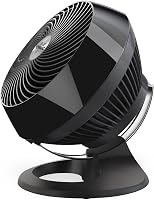
Vornado 660 Large Air Circulator, Black: Best for focused circulation
- 584 CFM airflow
- Airflow reaches up to 100 ft
- 4 speeds
- 90-degree adjustable tilt
Its adjustable tilt and four speeds suit buyers who want to aim a compact circulator across a room or toward a seating area.
Pros
- 90-degree adjustable tilt
- 4 speeds
- Compact floor placement
Cons
- Lowest stated CFM in this group
- No oscillation
The Vornado 660 Large Air Circulator suits a room where you want a compact fan that aims air across the space. It has 4 speeds and a 90-degree adjustable tilt, so you can direct airflow toward a seating area or along a clear path.
Its stated airflow is 584 CFM, the lowest in this group. That makes it a better fit for directed circulation and smaller placement spaces than for buyers whose first priority is the greatest volume of moving air.
The 660 has push-button controls on top and a removable grille for cleaning. At 15 in tall, it can sit on the floor near a wall or beside furniture without taking up the vertical space of a pedestal fan.
Choose it for directional circulation in a compact form. Skip it if you want automatic oscillation or a fan that sweeps a broad room without manual repositioning.
If you're comparing Vornado circulators, see Vornado 630 vs 660.
Lasko Wind Machine 3301 20-inch Floor Fan: Best for targeted airflow
- 2000 CFM airflow
- 20-inch blade
- 3 speeds
- 360-degree pivoting head
A pivoting head and carry handle suit buyers who want to direct air at hot spots or move the fan between rooms.
Pros
- Strong stated airflow for a portable floor fan
- Pivoting head directs air
- Carry handle
Cons
- Manual controls
- Wide floor footprint
The Lasko Wind Machine 3301 suits a large room with a hot spot you want to target. Its 20 in blade and 2000 CFM airflow provide a strong stream, while the head pivots 360 degrees to direct air where you need it.
Three speeds let you adjust the output, and a carry handle helps when you want to move the fan from room to room. Its long floor footprint makes placement beside a walkway less convenient than with a tower fan.
Use the pivoting head to aim air along a room or toward a seating area. It does not oscillate automatically, so it works best when a fixed direction suits your layout.
Choose it when you want a portable floor fan with a pivoting head. Skip it if you need a narrow footprint or hands-free coverage across several seating spots.
For a clearer explanation of this fan style, read what a high-velocity fan is.
Vornado 753 OSC Oscillating Air Circulator: Best for shared seating
- 1763 CFM airflow
- Oscillation
- Remote control
- Auto mode
Oscillation, adjustable tilt, and a remote suit a shared room where you want flexible control and airflow across multiple seats.
Pros
- Oscillation for moving air across a wider area
- Remote included
- Auto mode
Cons
- 3 speeds
- No stated room-size rating
The Vornado 753 OSC suits a shared room where you want a floor circulator that can sweep air across the space. It has 1763 CFM airflow, oscillation, adjustable tilt, and a remote for changing settings from across the room.
Three speeds and Auto mode give you control over operation. Its floor placement takes up less room than the 30 in commercial pedestal fan, but it is still a floor-standing option rather than a slim tower.
A removable grille helps with cleaning, and a scent pad provides an option for adding fragrance. The combination of oscillation and adjustable direction suits an open room where air needs to move across several seating spots.
Choose it if you want a remote controlled circulator that can oscillate. Skip it if you need more speed settings or the high-volume output of a commercial fan.
For a taller style in a living room, compare the best standing fans for living rooms.
DREO Smart Tower Fan, 40 to 45-inch Adjustable: Best for changing airflow height
- 1473 CFM airflow
- Adjusts from 40 to 45 in
- 90-degree oscillation
- App and remote control
Adjustable height lets you change where airflow lands, with app or remote controls for settings.
Pros
- Height adjusts from 40 to 45 in
- App and remote control
- 90-degree oscillation
Cons
- Less oscillation than the 120-degree tower pick
- No stated room-size rating
The DREO Smart Tower Fan, 40 to 45-inch Adjustable suits a room where you want to change the height of the airflow. It adjusts from 40 to 45 in, offers 90-degree oscillation, and has app, remote, and touch controls.
Its stated airflow is 1473 CFM, close to the other DREO tower model here. Nine speeds and 4 modes give you settings for different conditions, while the 12-hour timer can shut it off at a chosen time.
The height adjustment can help direct airflow from a couch, desk, or bed. Its oscillation range is narrower than the DREO 120-degree model, so consider how much of the room you want the moving breeze to cover.
Choose it if changing the height and controlling it from an app or remote matters. Skip it if broad oscillation is your main priority.
If your main concern is matching a fan to room dimensions, review our fan size guide.
Levoit 1472 CFM Tower Fan: Best for quiet rooms
- 1472 CFM airflow
- 90-degree oscillation
- 5 speeds
- 22 dB stated noise level
This tower fan combines oscillation and several operating modes with a stated low noise level for rooms where quieter operation matters.
Pros
- 5 speeds and 4 modes
- 90-degree oscillation
- Auto mode
Cons
- No stated room-size rating
- AC motor
The Levoit tower fan suits a large room where quieter operation is a priority. It has 1472 CFM airflow, a stated noise level of 22 dB, and 90-degree horizontal oscillation.
Five speeds and 4 modes give you options for changing airflow. Auto mode adjusts fan speed according to room temperature, and a remote lets you change settings without walking to the fan.
Its 42.4 in height and slim base suit a room where floor space is at a premium. The 90-degree sweep covers less angle than the DREO 120-degree tower, so choose based on where the fan will sit in relation to the people using the room.
Choose it for a slim fan with a stated low noise level and several modes. Skip it if you want wider oscillation or the directional reach of a larger floor fan.
For a more detailed look at tower-fan cleaning, see how to clean a tower fan without disassembly.
iLiving 30-inch Commercial Pedestal Fan: Best for industrial spaces
- 7261 CFM airflow
- 30-inch aluminum blades
- 58 lb
- 9 ft cord
High airflow and heavy metal construction suit very large indoor spaces where strong circulation matters more than easy repositioning.
Pros
- Highest stated airflow in this group
- 30-inch aluminum propeller
- Includes a 9 ft cord
Cons
- Heavy at 58 lb
- Large 78 in height
The iLiving 30-inch Commercial Pedestal Fan suits a very large indoor space where high-volume air movement is the priority. Its 7261 CFM airflow is the highest stated in this group, and its 30 in aluminum propeller sits inside a heavy-duty steel body.
This fan is 58 lb and 78 in tall, so plan its position before setting it up. It is easier to choose a permanent spot than to move it often between rooms.
It includes a 9 ft cord, wall or pedestal hardware, a column, and a hex key. The pull-chain control is simple to reach, but this large fan is a poor fit for tight rooms or walkways.
Choose it for a large indoor space with room for a tall, heavy fan. Skip it if you need a quiet bedroom fan, easy repositioning, or a slim footprint.
For smaller floor options, compare the best floor fans for home cooling.
How should you choose a fan for an open floor plan?
For an open floor plan, choose a fan that can direct air through a clear route or sweep it across the places where people sit. A wide room with separate seating zones may need more than one fan.
Think about the room before comparing features. A long narrow space gives a fixed-direction fan a clear path, while a wide living and dining area may benefit from oscillation that reaches several seats.
A high-volume model such as the iLiving suits a space where strong air movement is the main goal and the fan can stay in one place. For a specific hot spot, the pivoting Lasko can point air toward it.
Oscillating towers and pedestal fans offer a moving breeze with a smaller floor footprint than a large-blade fan. A compact circulator can instead aim air along a path, but you'll need to choose its direction and position carefully.
Measure the room and note the distance from likely fan positions to your main seating area. The guide to choosing a fan size for your room can help you think through those measurements.
How do airflow, oscillation, and fan shape affect a large room?
Airflow describes how much air a fan moves, while oscillation and direction determine where that air goes. A large CFM number alone does not tell you whether the breeze will reach a seat behind furniture or around a corner.
CFM can help you compare models that publish the same measure. Use it as one part of the decision, alongside fan placement, the room's shape, and whether you want a strong stream or a broader sweep.
Oscillation moves the airflow side to side across a wider angle. It can suit rooms with multiple occupied spots, but the fan still needs a clear line to the areas where people sit.
A pivoting or tilting head lets you set a direction. That can work well down a long room or toward a warm area, though a fixed stream won't automatically move to another seat.
Tower fans save floor width and often pair a slim body with oscillation. Pedestal fans raise the airflow and may offer height adjustment, while floor circulators and high-velocity fans can aim a more direct stream.
For a side-by-side look at the tradeoffs, read tower fan vs floor fan. If you want to learn how fan direction changes room airflow, see which way a fan should face.
How do you place and set up a large-room fan?
Place the fan where its airflow has an open route toward the people or area you want to cool. Aim a fixed fan across the room, or use oscillation to sweep air between several seating spots.
Before assembly, choose a level location near a suitable outlet and check that the cord can reach without crossing a walkway. For a tall or heavy fan, leave enough room to assemble it safely and avoid moving it across the floor while powered.
Set the fan on a stable surface and follow the instructions for its base, height, tilt, and controls. For the iLiving pedestal model, plan the position first because its listed weight and height make frequent repositioning impractical.
Start at a low or moderate speed and point the airflow toward the occupied area. Increase the speed only if the breeze needs to travel farther, and adjust the angle if it is striking a wall or furniture.
For an oscillating fan, check that its sweep reaches the seats you care about. If the breeze passes through an empty part of the room, reposition the fan instead of relying on a higher speed.
Avoid placing a fan behind a large sofa or aiming it into a wall. A clear path gives the moving air a better chance of reaching people in the room.
For more practical placement ideas, read how to cool a room with a fan. That guide covers ways to make airflow useful when a room feels warm.
How can you keep a large-room fan working well?
Regular dust removal helps keep a fan's air path clear and its exterior presentable. Unplug the fan before cleaning and follow the care instructions for its model.
Wipe accessible surfaces with a soft cloth and remove dust from the grille or air outlets as directed. Avoid spraying liquid into the motor, controls, or electrical openings.
Fans with a removable grille may allow easier access to dusty areas, but the exact cleaning steps vary. Don't force a grille or try to take apart a tower fan unless its instructions explain how.
Check the base, fasteners, and cord periodically for visible damage or looseness. Stop using a fan with a damaged cord or unstable base until the issue is addressed according to the manufacturer's instructions.
A common mistake is letting dust build up because the fan still turns on. Dust can collect around grilles and outlets, so include the fan in routine room cleaning rather than waiting for a visible layer.
For a model-specific cleaning routine, see how to clean a floor fan. Tower-fan owners can use the guide to cleaning a tower fan without disassembly.
What mistakes should you avoid when buying a fan for a large room?
The biggest buying mistake is choosing by CFM alone. A fan can have high stated airflow yet still be poorly placed for your seating area, while a lower-output circulator may fit a focused airflow route.
Don't assume a single fan will reach every part of an open floor plan. Furniture, walls, room proportions, and separate seating zones can make airflow uneven.
Avoid buying a large-blade or commercial fan before checking its footprint and height. The iLiving is powerful by its stated airflow, but its size and weight make it a poor match for compact rooms or frequent moves.
Don't choose a tower fan solely because it looks slim. Check its oscillation angle, controls, and whether its airflow direction suits your room.
Another common mistake is aiming the fan directly at an unoccupied wall or letting the cord cross a walkway. Pick the location first, keep the route clear, then adjust speed and direction.
Finally, don't expect a fan to lower the room's air temperature. It moves air to make conditions feel more comfortable, and works best when aimed where people are present.
Which fan is best for a large room?
Choose the iLiving when the room is very large, you want high-volume air movement, and you have a stable place for a tall, heavy fan. Choose the Lasko when you need a strong, portable stream that you can aim at a hot spot.
Pick the DREO pedestal fan when adjustable height, tilt, and oscillation help reach different seats. Choose the Vornado 660 when compact, directed circulation matters more than the highest CFM or automatic sweep.
For a broad oscillating tower with app and voice controls, choose the DREO 120-degree model. The Levoit suits buyers who put a stated low noise level high on the list, while the Vornado 753 OSC offers a remote and oscillation in a floor circulator.
Before deciding, measure the room, identify the seats that need airflow, and check how much floor space you can spare. For a broader comparison of fan types, start with room fans for cooling.
Our top 3 picks at a glance
-
1
Best for app-controlled rooms
DREO Smart Tower Fan, 120-Degree Oscillation
9.0/10 our score
See it on Amazon -
2
-
3
Best for focused circulation
Vornado 660 Large Air Circulator, Black
9.0/10 our score
See it on Amazon
Frequently asked questions
What type of fan is best for a large room?
A circulator or pedestal fan suits a large room when you want to move air across a wide area. A tower fan can fit a shared room where a slim shape and oscillation matter.
Compare airflow figures where available, then consider fan position, direction, and whether you need a focused stream or a broad sweep.
How many CFM should a fan have for a large room?
There is no single CFM target for every large room. Ceiling height, layout, furniture, and seating locations affect how airflow feels.
Use CFM to compare models, then consider the fan's position, direction, and oscillation for your room.
Can one fan cool an open floor plan?
One fan can move air through part of an open floor plan, especially when you can aim it down a clear path. Walls, furniture, and distant seating areas can limit airflow.
A second fan may help when separate spaces or persistent hot spots are hard to reach.
Should a large-room fan oscillate?
Oscillation sweeps air across a wider area, which suits a room with several seating spots. A fixed-direction fan may work better when you want to aim air down a long room or toward a particular hot spot.
Choose based on where people spend time.
Where should you place a fan in an open room?
Place the fan where its airflow has a clear path toward the area you want to cool. Aim a circulator across the room or toward a hot spot, and use oscillation to sweep multiple seats.
Keep walkways clear and follow the fan's placement instructions.