9 Best Box Fan for Garage (November 2026)
The best box fans for a garage include the Hurricane Classic Floor Box Fan (best overall), the Genesis 20" Box Fan for a home workshop, and the Amazon Basics 3-Speed Box Fan for Bedroom for light garage duty.
On this page (8 sections)
- The best box fans for a garage, ranked by use
- How these garage box fans compare
- How we compared these box fans for garage use
- What should you check before buying a box fan for a garage?
- How do you set up a box fan to cool a garage?
- Do you need a high velocity fan instead?
- Which box fan size fits a garage?
- Verdict: which box fan should you buy for a garage?
The best box fan for garage use is the Hurricane Classic Floor Box Fan, which pairs 2400 CFM of airflow with a 3.5-inch deep frame that tucks into a corner or window. If raw air movement matters more than anything, the MAN 20 Inch Box Fan is the raw-airflow pick here at 3500 CFM.
For a garage you also use as a workspace, the Vornado Model 80X gives you 99 speed levels and a timer.
A garage is a hard room to cool. It usually has a big door, thin walls, little insulation and a lot of stored stuff blocking airflow.
A box fan helps most when it moves a large volume of air and when you can aim it where you actually stand.
That makes airflow and frame depth the two specs that matter most. Weight matters too, because you'll likely carry the fan between the garage, the driveway and the house.
This guide ranks nine fans by those needs, then explains placement and venting so the fan you buy actually works.
Our picks at a glance
-
1

-
2

-
3
 Best for light garage duty
Amazon Basics 3-Speed Box Fan for Bedroom
9.6/10 our score
See it on Amazon
- 4
 Check it
BLACK+DECKER 9-Inch Frameless Box Fan
Best small fan for a workbench - 5
 Check it
Vornado Model 80X High Velocity Box Fan
Best for quiet, controlled airflow - 6
 Best for raw airflowCheck it
- 7
 Best for dusty, heavy-duty useCheck it
- 8
 Check it
BLACK+DECKER 20" Box Fan with 3 Speed
Best for simple window venting - 9
 Best budget-friendly floor fanCheck it
The best box fans for a garage, ranked by use
The Hurricane Classic earns the top spot because it balances strong airflow with a light, thin body. The rest of the list covers garages where you want more raw power, quieter control, a steel build or a small fan for a workbench.
Hurricane Classic Floor Box Fan: Best overall
- 2400 CFM at 1100 RPM
- 20-inch plastic blades
- Three quiet speeds
- 3.5-inch deep frame
The strongest all-around garage fan here: plenty of airflow, a slim frame and a light body you can move by hand.
Pros
- 2400 CFM for its size
- Only 3.5 inches deep
- Light at 7 lb
- Adjustable feet
Cons
- No tilt head
- Plastic blades and housing
This is the fan to buy first for most garages. It pushes 2400 CFM at up to 1100 RPM, which is enough to feel a real breeze across a one-car bay or through an open doorway.
The frame is only 3.5 inches deep. That matters in a garage, where you can set it on a shelf, in a window channel or against a wall without it sticking out into walkways.
At 7 lb, carrying it out to the driveway and back is easy.
Three speeds let you run it quiet in the evening and on high when the afternoon sun hits the door. Adjustable feet help it sit level on an uneven slab.
The polymer blades and housing suit indoor use. There's no tilt head, so aim it by turning the whole unit.
The 5-foot cable is short for a deep bay, so plan on an extension cord if the outlet is far away. Against the MAN and KEN BROWN fans it gives up raw power, but it fits in places those bulky units cannot.
Genesis 20" Box Fan: Best for a home workshop
- Copper motor
- Three speeds
- Carry handle
- 20-inch blade
A five-blade 20-inch fan with a copper motor and a carry handle, aimed at workshops and home garages rather than a bedroom.
Pros
- Copper motor
- Five blades
- Carry handle
- ETL listed with overload fuse
Cons
- No airflow figure published
- Knob controls only
Genesis targets the home workshop crowd. Its copper motor is the headline part, since copper motors are usually chosen for long-running performance, and the fan has five blades.
Three speeds and a top carry handle keep daily use simple. Genesis says the unit is ETL listed with UL approval and has an overload fuse in the plug, which is worth having in a garage with old wiring.
The five blades work with three speed settings, which suits a work area where you move around.
The design stays neutral enough to sit in a garage without looking like an industrial unit. It won't tilt to aim the air, so plan to move the whole fan when your work moves.
Genesis doesn't publish an airflow figure, so you're trusting the motor and blade count rather than a number. The manufacturer lists the controller as a knob.
Choose it if you want a 20-inch fan for a garage or workshop and value the copper motor and five-blade design. Look at the Hurricane first if you need the slimmest possible frame or a published airflow number.
Amazon Basics 3-Speed Box Fan for Bedroom: Best for light garage duty
- Three speeds
- Five blades
- Carry handle
- Extra-large feet
The lightest 20-inch fan here, with wide feet that keep it steady on a garage floor. Best when you mostly need air moving, not a wind tunnel.
Pros
- 5.8 lb and easy to carry
- Extra-large feet
- Three speeds
- Compact for its blade size
Cons
- No airflow figure published
- Thicker frame than the Hurricane
Amazon Basics makes the lightest 20-inch fan in this group at 5.8 lb, and the wide feet are the feature that matters for garage duty. A fan that stays put on a sloped or gritty floor is safer and less annoying.
Three speeds and five blades cover normal cooling and air circulation. The 6.8-inch depth is thicker than the Hurricane, so it takes a bit more room on a shelf or sill.
The 20.86-inch width and 21.33-inch height keep the footprint compact for its blade size.
Its real strength is portability. Carry it from the garage to the patio, then back in when you're done.
For a garage that only needs air moving rather than a hard blast, this is the simplest pick here. The 2-prong plug fits standard outlets without needing a ground, handy in older garages.
The trade-off against the top pick is airflow and frame depth. Buy it if light weight and steady feet matter more to you than maximum CFM.
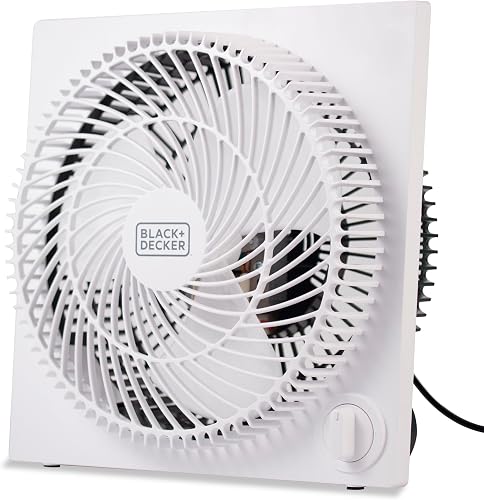
BLACK+DECKER 9-Inch Frameless Box Fan: Best small fan for a workbench
- 9-inch frameless design
- Three speeds
- 40 watts
- 2.73 lb
A desktop-sized fan for a bench, shelf or windowsill. It cools the person, not the whole bay, and sips power while doing it.
Pros
- Fits a bench or windowsill
- 2.73 lb
- 40 watts
- No assembly needed
Cons
- Covers one work spot only
- Front dial sits low
Not every garage fan needs to cool the whole bay. This frameless 9-inch fan sits on a workbench, shelf or windowsill and cools the spot where you're standing or sitting.
It weighs 2.73 lb and runs at 40 watts. Three speeds and a front dial make it easy to adjust while your hands are busy.
The square frameless body takes up very little bench space. The 59-inch cable gives you some reach from an outlet to the bench.
For a garage, think of it as personal cooling. Point it at your chest while you work at the bench, or set it on a window ledge to move air through a small opening.
A 9-inch blade moves far less air than the 20-inch fans here, so don't expect it to clear a whole bay.
It won't replace a 20-inch fan for a whole garage, and its airflow isn't published. Buy it as an add-on when the big fan is too much for a small work corner.
The front dial sits low, so you'll crouch a little to change speeds.
Vornado Model 80X High Velocity Box Fan: Best for quiet, controlled airflow
- 99 power levels
- Digital display and timer
- Built-in kickstand
- Removable grille
The most adjustable fan in this group, with variable speed and a timer. Pick it when you want a gentle breeze most of the time and a blast when needed.
Pros
- 99 speed levels
- Digital display and timer
- Kickstand tilts the airflow
- Vornado backs it for up to 5 years
Cons
- Heaviest pick here at 11.6 lb
- No airflow figure published
Vornado's 80X is the fan for a garage where you spend real time. It offers 99 power levels, so you can dial in a soft background breeze or push it up when the door is open and the heat rolls in.
The digital display and timer set it apart from the simple knob fans here. Set a timer so it shuts off after you leave the garage.
A built-in kickstand tilts the airflow up or down without moving the whole unit. Vornado's airflow design is meant to circulate air through the whole room rather than blow one narrow stream.
The removable grille makes cleaning easier, which matters in a dusty garage. Vornado says it backs the fan for up to 5 years.
The brushless motor is built for long, quiet runs. At 11.6 lb it's the heaviest pick here, so moving it between spots takes more effort.
Running it at low speed settings makes it a good option for a garage you use as an office or hangout spot. Buy it if you want precise control and quiet operation over maximum raw airflow.
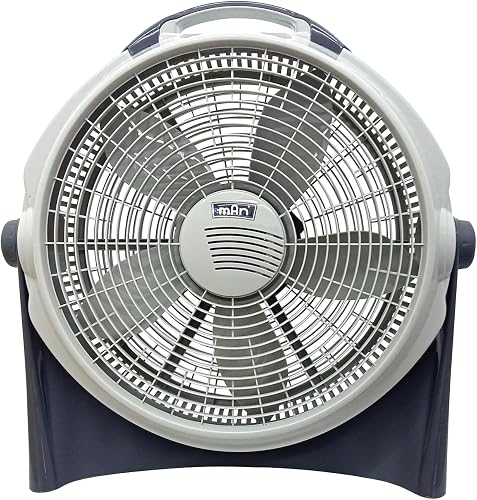
MAN 20 Inch Box Fan: Best for raw airflow
- 3500 CFM
- Three speeds
- Adjustable tilt
- 125W motor at 1500 RPM
The biggest air mover here by CFM, with a tilt head that aims the stream where you need it. Built for garage and shop work.
Pros
- 3500 CFM
- Tilt head aims airflow
- High-impact polypropylene body
- Meets NOM and UL standards
Cons
- Louder on high speed
- Bulkiest footprint here
When airflow is the whole point, the MAN 20 Inch Box Fan delivers. It moves 3500 CFM on high speed from a 125W motor at 1500 RPM, well above the typical box fan.
The tilt head lets you aim the stream up, down or straight ahead. In a garage that means you can point it at the open door to push hot air out, or at your work area for direct cooling.
The stream is focused enough to feel strong several feet away.
The housing and grille are high-impact polypropylene with a stable base. MAN says the fan meets NOM and UL standards and has a 1500 RPM motor built for all-summer running.
The company has made appliances in Mexico since 1955.
It's the bulkiest fan here at 24.8 inches wide and 7.4 inches deep, so it needs more floor or shelf room. It's loudest on high speed, so plan on low speed for a quiet garage.
Buy it for a large bay or shop where moving serious air matters more than a compact footprint.
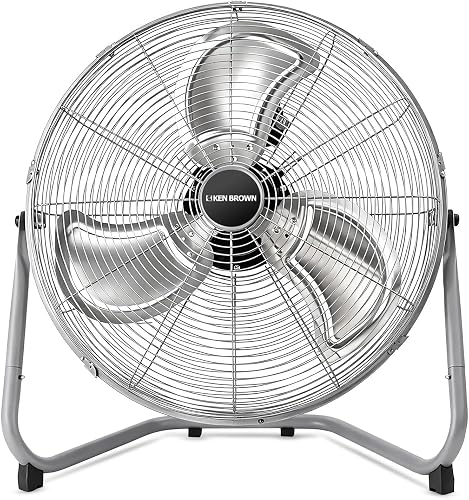
KEN BROWN 20 Inch Box Fan: Best for dusty, heavy-duty use
- 4700 CFM
- Metal construction
- 360° tilt
- Below 60 dB
The strongest airflow figure in this roundup, wrapped in steel and aluminum. Suits a shop or workshop that needs serious ventilation.
Pros
- 4700 CFM
- Galvanized steel and aluminum build
- 360° tilt
- Thermal overload protection
Cons
- Deepest unit here
- Rust-proof coating still needs care in damp air
The KEN BROWN fan claims the highest airflow figure in this roundup at 4700 CFM, and it's built like shop equipment. Galvanized steel, aluminum blades and a powder-coated rust-proof finish suit a working garage.
It also has a 360° tilt so you can aim the air in any direction. KEN BROWN says it runs below 60 dB even at full speed, which is reasonable for this much airflow.
Thermal overload protection and a fused 3-prong plug add safety for garage wiring. The dual ball bearing motor is sealed to keep dust out, which matters in a woodshop or a bay with grit in the air.
The trade-off is size and weight. At 10.16 inches deep and 22.83 inches wide, it's the deepest fan here.
That's the price of the metal build and the airflow. The three-blade design is tuned for a strong, straight stream rather than wide coverage.
Buy it if your garage or workshop needs serious ventilation and you can leave the fan in place. Skip it if you plan to carry the fan around often.
BLACK+DECKER 20" Box Fan with 3 Speed: Best for simple window venting
- 1200 CFM
- 80W copper motor
- Three speeds
- Rain-resistant motor housing
A plain 20-inch fan that works well set in a window or doorway to push hot air out. The rain-resistant motor housing helps if weather turns.
Pros
- Rain-resistant motor housing
- Carry handle
- Stabilizing feet
- 6 ft cord
Cons
- Lowest CFM here
- Mechanical rotary control only
This 20-inch BLACK+DECKER fan is the simplest way to vent a garage. Its 1200 CFM and 80W copper motor are modest, but the rain-resistant motor housing means you can leave it in a window or doorway when the weather turns.
That makes it a good exhaust fan. Face it outward in a window or open doorway and it pushes hot, stale air outside.
The carry handle and stabilizing feet help when you move it between the garage and the house. The 6-foot cord and recessed cord storage keep the cable tidy when you carry it.
Three speeds and a rotary dial keep operation basic. The 4.13-inch depth is slim enough for window frames and narrow gaps.
At 63.3 dB on high it's noisier than the KEN BROWN, which is rated below 60 dB.
It won't match the airflow of the top picks, so don't buy it for a large open bay that needs a strong breeze. Buy it for a small garage or for venting one window well.
PELONIS 3-Speed: Best budget-friendly floor fan
- 2295 CFM
- Three speeds
- 55W motor
- 6.94 lb
A light 20-inch fan with a solid airflow figure for the power it draws. A good first garage fan if you want to spend less.
Pros
- 2295 CFM at 55W
- Under 6.9 lb
- Built-in handle
- Three speeds
Cons
- Plastic housing
- Shortest warranty here at 1 year
PELONIS offers a solid airflow figure for the money. Its 2295 CFM comes from a 55W motor, so it moves nearly as much air as the top pick.
It weighs just under 7 lb.
Three speeds and a built-in handle make it easy to move between the garage floor and a window. The 5.6-inch depth is thin enough to fit most window openings.
PELONIS lists it as a 21-inch blade length with a 20-inch fan body.
It's designed for floor, table or window use, so it adapts to how your garage is laid out. A 34 dB noise figure makes it one of the quietest fans here, so it works well in a garage you use in the evening.
The plastic housing won't take the abuse a steel fan would.
Buy it as a first garage fan or as a second fan to pair with an exhaust setup. Look at the Hurricane or MAN first if you need maximum airflow or a tougher build.
The 1-year warranty is the shortest in this group.
How these garage box fans compare
The comparison table lines up airflow, size and weight so you can match a fan to your garage's shape and how you plan to use it. A fan with high CFM but a deep frame may not fit where a slimmer one will.
| Product | Best for | Airflow | Size | Weight | Our score |
|---|---|---|---|---|---|
| Hurricane Classic Floor Box Fan | overall | 2400 CFM | 3.5 x 20 x 20 in | 7 lb | 9.7 |
| Genesis 20" Box Fan | a home workshop | Not published | 20-inch box | 9.7 | |
| Amazon Basics 3-Speed Box Fan for Bedroom | light garage duty | Not published | 6.8 x 20.86 x 21.33 in | 5.8 lb | 9.6 |
| BLACK+DECKER 9-Inch Frameless Box Fan | small fan for a workbench | Not published | 4.25 x 10.9 x 10.9 in | 2.73 lb | 9.5 |
| Vornado Model 80X High Velocity Box Fan | quiet, controlled airflow | Not published | 6 x 20 x 20.15 in | 11.6 lb | 9.2 |
| MAN 20 Inch Box Fan | raw airflow | 3500 CFM | 7.4 x 24.8 x 25.2 in | 4 kg | 8.9 |
| KEN BROWN 20 Inch Box Fan | dusty, heavy-duty use | 4700 CFM | 10.16 x 22.83 x 24.21 in | 8.5 | |
| BLACK+DECKER 20" Box Fan with 3 Speed | simple window venting | 1200 CFM | 4.13 x 20.67 x 21.06 in | 7.1 lb | 8.1 |
| PELONIS 3-Speed | budget-friendly floor fan | 2295 CFM | 5.6 x 20.7 x 21.3 in | 6.9 lb | 8.1 |
Our score weighs specs, features and buyer feedback against what you're shopping for. For a garage, airflow and frame depth carry the most weight, followed by weight and build material.
The Hurricane and Genesis tie at the top because each balances airflow with a practical body. The KEN BROWN fan has the most airflow but loses points for its depth.
The small BLACK+DECKER fan earns a high score for its niche, not for whole-garage cooling.
Where each fan gives ground
The Hurricane has no tilt head, so you lose some aiming flexibility. The Genesis leaves its airflow unpublished and adds nothing beyond a knob.
The Amazon Basics is the easiest to carry but the thickest of the light fans.
The Vornado costs more than the simple fans and weighs the most, so it only pays off if you'll use the timer and variable speed. The MAN and KEN BROWN fans both need floor space and both get loud on high.
The BLACK+DECKER 20-inch fan has the lowest airflow here. The PELONIS trades build toughness for a low power draw.
How we compared these box fans for garage use
We compared published airflow, frame depth, weight and build material, since those decide whether a fan fits a garage and how easily you can move it. We also weighed speed controls, tilt and safety features like fused plugs and thermal protection.
Airflow figures are the main sorting tool, but not every fan publishes one. When a brand doesn't, we scored the fan on its motor, blade count and stated use instead of guessing a number.
Weight and depth came next. A garage often has limited floor space and narrow window channels, so a fan that's 3.5 inches deep has an advantage over one that's 10 inches deep.
A 5.8 lb fan you carry out to the driveway beats an 11.6 lb one you leave in the corner.
Finally we looked at controls. A simple knob is fine for a fan that stays put.
A fan with variable speeds and a timer suits a garage you use as a workspace. Our scores reflect those priorities for garage buyers.
What should you check before buying a box fan for a garage?
Start with airflow, then match the fan's size to where it will sit. A garage fan that moves a lot of air but doesn't fit your window or corner won't help.
Airflow in CFM
CFM tells you how much air the fan moves. For a one-car garage, 2,000 CFM or more gives a noticeable breeze.
A two-car bay or a hot, still space does better with 3,500 CFM or more.
Published figures range widely here, from 1200 CFM on the BLACK+DECKER to 4700 CFM on the KEN BROWN. The Hurricane's 2400 CFM is a good middle ground for most garages.
Higher CFM usually means more noise on high speed, so weigh both.
Frame depth and window fit
Measure your window channel or the shelf where the fan will sit before you buy. Slim fans like the Hurricane at 3.5 inches and the BLACK+DECKER at 4.13 inches fit narrow openings.
The KEN BROWN at 10.16 inches deep needs a proper floor spot. If you plan to run the fan as a window exhaust, the depth is the first number to check.
Build material and dust
A garage is dusty, so grille design and material matter. Steel and aluminum fans like the KEN BROWN handle rough use better.
Plastic fans are lighter and easier to clean with a brush. A removable grille, as on the Vornado, makes cleaning simpler.
Wipe the blades and grille each season so dust doesn't cut airflow.
Speed controls and aiming
A three-speed knob covers most needs. Variable speed and a timer help if the garage doubles as a workspace.
A tilt head lets you aim the air without moving the fan. The MAN, KEN BROWN and Vornado all tilt.
The Hurricane and Genesis do not.
Weight and cord length
Check the weight if you plan to move the fan between the garage and the house. The lightest 20-inch fans here are around 6 lb.
The Vornado is much heavier at 11.6 lb. Cord length matters too: a 5-foot cable limits where you can place the fan without an extension cord.
The BLACK+DECKER 20-inch gives you a 6-foot cord.
How do you set up a box fan to cool a garage?
The best setup uses the fan to push hot air out rather than just stirring it around. Set the fan in a window or doorway facing outward, and open another opening so fresh air can come in.
This cross-flow arrangement works better than pointing a fan at yourself in a closed garage. Hot air leaves through the fan opening, and cooler outside air enters through the second opening.
Run the fan on high during the hottest part of the day.
For direct cooling at a workbench, aim a fan at the person instead. A smaller fan like the 9-inch BLACK+DECKER works well here.
If you want to compare airflow setups, our guide to shop fans for garage use covers bigger options for serious ventilation.
Do you need a high velocity fan instead?
Not always. A high velocity fan moves air through a narrower opening and is usually built for tougher spaces.
A 20-inch box fan with 2,400 CFM or more covers most home garages.
If your garage is large, open and very hot, a high velocity model may move air more efficiently. Our explainer on what a high velocity fan is covers when the extra airflow is worth the noise.
For a standard residential garage, a box fan like the Hurricane is simpler and lighter.
Which box fan size fits a garage?
A 20-inch fan is the right size for most garages. It moves enough air to feel a breeze and fits in most windows.
A 9-inch fan suits a workbench or small corner, not a whole bay.
The 20-inch fans here range from 1200 to 4700 CFM. If you want a wider choice of 20-inch models, our roundup of the best 20 inch box fans compares airflow and features.
For a quieter room in the house, a bladeless fan may suit better than a garage box fan.
Verdict: which box fan should you buy for a garage?
Buy the Hurricane Classic Floor Box Fan for most garages. Its 2400 CFM, 3.5-inch frame and 7 lb body make it easy to place and easy to move.
Pick the MAN 20 Inch Box Fan when airflow is the priority and you have floor space for a bulkier unit. Choose the Vornado Model 80X if the garage is also a workspace and you want precise, quiet control.
The KEN BROWN fan is the pick for a shop that needs maximum ventilation and a steel build.
Whichever you choose, set it in a window or doorway to push hot air out, and keep a second opening clear so fresh air can replace it. That single setup step does more for garage comfort than any feature on this list.
Our top 3 picks at a glance
-
1
-
2
-
3
Best for light garage duty
Amazon Basics 3-Speed Box Fan for Bedroom
9.6/10 our score
See it on Amazon
Frequently asked questions
How many CFM do I need to cool a garage?
For a one-car garage, aim for at least 2,000 CFM if you want to feel a steady breeze. A two-car garage or a hot, still bay does better with 3,500 CFM or more.
Match airflow to how open the space is before you buy.
Can a box fan pull air out of a garage window?
Yes. Set the fan facing outward in a window or doorway so it pushes hot air outside.
Open a second vent, door or window elsewhere so fresh air can come in and replace it.
This cross-flow setup cools faster than stirring the same air.
Is a high velocity fan better than a box fan for a garage?
A high velocity fan usually moves more air through a narrower opening and is built to last in rougher spaces. A box fan is lighter and easier to carry around.
For most garages, a 20-inch box fan with 2,400 CFM or more is enough.
Where should I put a box fan in my garage?
Put it near the work area at first, angled toward where you stand. For whole-garage cooling, set it in a window or door as an exhaust fan.
Keep it off the floor if dust and grit collect there, and keep the cord out of walkways.
Do box fans use a lot of electricity?
No. A typical 20-inch box fan draws around 40 to 80 watts on high, which is about the same as a light bulb.
Running one all afternoon costs very little compared with an air conditioner.
Smaller 9-inch fans use even less.


