9 Best Box Fan for Window (November 2026)
The best box fans for window use include the Hurricane Classic Floor Box Fan for strong window exhaust, the Genesis 20" Box Fan for hot-weather cooling, and the Amazon Basics 3-Speed Box Fan for Bedroom for bedroom windows.
On this page (7 sections)
The best box fan for window use for most people is the Hurricane Classic 20-inch Floor Fan. Its 2,400 CFM airflow is the strongest here, and its 20 x 20-inch frame fits a standard double-hung window.
A box fan in a window works two ways. Point the blades into the room to pull cooler night air inside, or turn it around to push hot air out.
The best box fan for window duty needs enough airflow to matter and a frame that sits safely on your sill.
This guide compares nine models on airflow, size, weight and window fit. It also covers mounting and safety.
For the wider picture on moving air through a home, see our guide to how to cool a room with a fan.
Our picks at a glance
-
1

-
2

-
3
 Best for bedroom windows
Amazon Basics 3-Speed Box Fan for Bedroom
9.6/10 our score
See it on Amazon
- 4
 Check it
BLACK+DECKER 9-Inch Frameless Box Fan
Best for small windows - 5
 Check it
Vornado Model 80 High Velocity Box Fan
Best for whole-room circulation - 6
 Check it
Vornado Model 80X High Velocity Box Fan
Best for timer and display controls - 7
 Check it
COMFORT ZONE Box Fan with Carry Handle
Best for garage and shop windows - 8
 Check it
COMFORT ZONE 20-Inch Portable Box Fan
Best for moving between rooms - 9
 Best for desk and sill placementCheck it
The best box fans for window use, by airflow and fit
The Hurricane Classic leads on raw airflow, while the Vornado Model 80 suits whole-room circulation and the BLACK+DECKER 9-inch fits windows the big models can't.
Hurricane Classic Floor Box Fan: Best for strong window exhaust
- 2,400 CFM airflow
- 3 quiet speed settings
- 20-inch frame fits double-hung windows
- Slim 3.5-inch depth
The highest airflow in this group, in a square frame that fits a standard double-hung window without an adapter.
Pros
- Highest CFM here
- Slim frame for window ledges
- Three quiet speeds
Cons
- 7 lb needs a secure sill
The Hurricane Classic is the pick when you want a window fan that visibly changes the room. It moves 2,400 CFM at 1,100 RPM, the highest airflow figure in this group, so it can pull a strong breeze through a doorway or push hot air out fast.
Its frame measures 3.5 inches deep and 20 inches square. That thin profile sits well on a narrow sill, and the adjustable feet help it stand level.
At 7 lb it's light enough to lift out for rain, though a window sash or lock should still hold it in place.
Three speeds let you run it gentle at night and strong in the afternoon. The plastic blades keep the weight down.
The polymer build and sturdy motor are meant for long, reliable runs in a workshop or greenhouse as much as a bedroom. A 5-foot cable reaches most sills without an extension cord.
The trade-off against the Vornado is weight and price tier, not airflow. The Hurricane is the exhaust and intake specialist; the Vornado is the circulation specialist.
Buy it for the strongest window breeze. Skip it for a sliding window opening under 20 inches tall.
Genesis 20" Box Fan: Best for hot-weather cooling
- Copper motor
- 3 speed settings
- Carry handle
- 5 blades
A copper motor and five blades push steady airflow for hours, and the carry handle makes moving it between windows easy.
Pros
- Copper motor
- Carry handle
- Fuse in the plug
Cons
- No published CFM figure
The Genesis is the other 9.7 here, and it earns that score on build rather than a CFM number. Its copper motor is built for long runs, which suits a fan left in a window through a hot week.
It has five blades and three speed settings, plus a carry handle on top. The handle matters more than it sounds: you can move the fan from a bedroom window to a kitchen one without tipping it.
A fuse in the plug adds overload protection, and Genesis says the unit is ETL listed with UL approval. That fuse is a small safety detail worth having when the fan sits near a window sash.
The matte white finish blends with most window trim. The fan rests on the floor or a sill, so check that your sill is flat before you commit.
Where it loses ground to the Hurricane is published airflow: Genesis doesn't quote a CFM figure. If you want a number to compare, the Hurricane or COMFORT ZONE models give you one.
Buy it for steady all-day window cooling. Skip it if you want a quoted airflow figure to size against your room.
Amazon Basics 3-Speed Box Fan for Bedroom: Best for bedroom windows
- 67 watts
- 5.8 lb with carry handle
- Extra-large feet
- 5 blades
The lightest 20-inch model here, so it lifts in and out of a window easily. Low, medium and high settings let you run it quietly at night.
Pros
- Light at 5.8 lb
- Three speeds
- Wide feet for stability
Cons
- Deepest frame here
The Amazon Basics model is the bedroom pick. At 5.8 lb, it's the lightest 20-inch fan here, so lifting it into a window and pulling it out at night is a one-hand job.
That lightness also means it shifts easily if a gust catches it, so seat it firmly.
It has five blades, three speeds and a 67-watt draw. That's low enough to run all evening without a second thought about the bill.
The extra-large feet keep it steady when it stands on the floor between window sessions. Amazon Basics lists it as a table fan as well as a floor fan, so it can sit on a wide sill.
At 20.86 inches wide, the frame is wider than most 20-inch fans here, so measure your window opening before you order. The 6.8-inch depth is also deeper than the Hurricane's, which matters on a shallow sill.
The 6.8-inch depth is also deeper than the Hurricane's, which matters on a shallow sill.
A 2-prong plug fits any standard North American outlet.
Its strength is quiet, gentle airflow for sleeping rather than blasting a whole room. If your goal is a strong through-draft, the top pick does more.
Buy it for night-time bedroom window use. Skip it if your window opening is under about 21 inches wide.
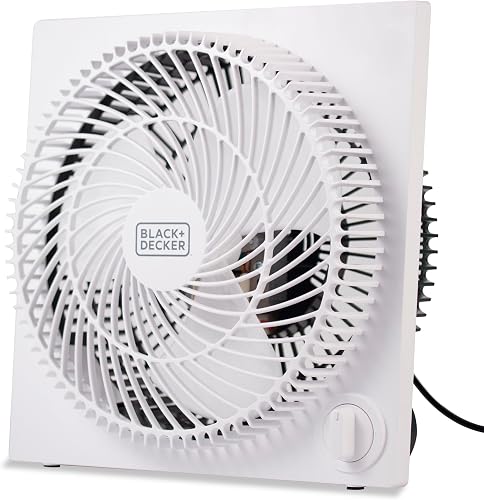
BLACK+DECKER 9-Inch Frameless Box Fan: Best for small windows
- 9-inch blade
- 40 watts
- 2.7 lb
- Frameless square design
A small square fan that fits narrow or sliding windows where a 20-inch model won't. It uses 40 watts, so you can leave it running all evening.
Pros
- Fits small windows
- Low 40-watt draw
- Very light
Cons
- Less air movement than 20-inch models
The BLACK+DECKER 9-inch is the answer when a 20-inch fan simply won't fit. Its frameless square body suits narrow windows, sliding windows and sills that can't take a wide frame.
At 2.7 lb and 40 watts, it's the easiest fan here to place and the cheapest to run. The front dial gives you high, medium and low without any setup.
BLACK+DECKER says it needs no assembly. The matte white body is 10.9 inches wide and 10.9 inches tall, so it uses very little sill space.
It won't cool a large room on its own. Think of it as a personal breeze for a small bedroom, a home office or a single window where you sit nearby.
A 59-inch cable gives you room to reach an outlet near a windowsill or counter.
The trade-off is airflow. A 9-inch blade moves far less air than a 20-inch one, so use it where you want a light draft rather than a room-wide exchange.
In a window it stirs air near the opening more than it pulls a full draft through a house.
Buy it for small or sliding windows. Skip it if you need to move air through a whole living room.
Vornado Model 80 High Velocity Box Fan: Best for whole-room circulation
- 5 speed settings
- Removable grille
- 16.15-inch blade
- 20-inch frame
Five speeds and a deep-pitched blade move air across a whole room rather than just at the window. The removable grille makes seasonal cleaning quick.
Pros
- Five speeds
- Removable grille
- 5-year replacement support
Cons
- Heavy at 13.5 lb for a sill
The Vornado Model 80 is built for circulation, not just window duty. It has five speeds, a 16.15-inch blade in a 20-inch frame and a removable grille that makes cleaning simple at the end of the season.
Vornado designs its fans to push air across a whole room, so this one works well set back from the window or aimed through a doorway. The blade sits inside a 20 x 20.15-inch frame that is 6 inches deep.
It's heavier than the Hurricane at 13.5 lb. That weight makes it more stable on a floor but harder to lift onto a sill, so plan to keep it on the floor or a sturdy ledge.
The steel build adds to that heft. Vornado backs it with up to five years of replacement support.
Against the Hurricane, it trades peak CFM for speed choice and cleaning access. Against the Model 80X, it trades digital controls for simpler buttons and a heavier, sturdier frame.
Buy it for whole-room air movement from a window. Skip it if you need to lift the fan in and out daily.
Vornado Model 80X High Velocity Box Fan: Best for timer and display controls
- Digital display
- Built-in timer
- 99 power levels
- Kickstand for vertical airflow
Digital controls and a timer let you set the fan to run for a set stretch and shut off on its own. The kickstand tilts airflow up or down.
Pros
- Timer
- 99 speed steps
- Lighter than the Model 80
Cons
- Controls sit on the unit
The Vornado Model 80X adds digital controls to the Model 80 formula. It has a built-in timer and 99 power levels, so you can set a gentle overnight breeze and have it shut off before morning.
That is a real advantage for a window fan you want running while you sleep.
Its kickstand tilts the airflow up or down, which helps when the fan sits below the window line. The removable grille returns for easy cleaning, and Vornado offers the same five-year replacement support.
It's lighter than the Model 80 at 11.6 lb and shares the same 20 x 20.15-inch, 6-inch-deep frame.
The controls sit on the unit itself, so you'll reach for the fan each time you want a change. There's no remote in the box, and the 99 levels mean you'll settle on a favorite setting rather than adjust constantly.
Choose it over the Model 80 when the timer matters, such as running a window fan for a set stretch each evening. Choose the Model 80 when you'd rather set a speed and leave it.
Buy it for timed overnight window runs. Skip it if you want a remote or a wall switch.
COMFORT ZONE Box Fan with Carry Handle: Best for garage and shop windows
- 901.8 CFM airflow
- 3 speeds
- Carry handle
- 20-inch frame
A workhorse for a garage or workshop window, with a carry handle and rotary speed dial that's easy to use with dirty hands.
Pros
- Carry handle
- Simple rotary dial
- Published CFM figure
Cons
- Lower airflow than the top pick
The COMFORT ZONE CZ200A is the garage and workshop pick. It quotes 901.8 CFM and 15.03 ft/sec of airflow, enough to keep air moving in a hot shop window or a converted garage.
A carry handle and rotary dial make it easy to use with work gloves on. It runs three speeds and stands on its own.
The 20-inch blade sits in a 21 x 22-inch frame, slightly larger than the Hurricane's and a little deeper at 5 inches. At 7 lb it lifts easily when you want to move it.
It's a plain, painted plastic fan built for utility spaces rather than bedrooms. The airflow is lower than the top pick, so it's the second choice for a living room window.
Its rotary control is simpler than a touch panel, which helps in a dusty shop.
If your window is in a garage or shed and you want a fan you can grab and move, this one fits. For a bedroom, the Amazon Basics model is lighter and quieter.
Buy it for a garage or shop window. Skip it for a bedroom where noise matters.
COMFORT ZONE 20-Inch Portable Box Fan: Best for moving between rooms
- 640 CFM airflow
- 3 speeds
- Carry handle
- Lightweight build
The lightest way to get a 20-inch fan you can carry from a bedroom window to a kitchen one. Lower airflow suits small rooms.
Pros
- Easy to carry
- Three speeds
- Fits standard windows
Cons
- Lowest CFM of the 20-inch picks
The COMFORT ZONE 20-inch portable model is the lightest way to get a 20-inch fan you can carry around. At 7 lb with a handle, it moves from a bedroom window to a kitchen window without fuss.
It quotes 640 CFM, the lowest of the 20-inch picks here. That's still enough for a small room, and the three-speed rotary dial is simple to use.
The lightweight build is the point: this is the fan you reposition several times a day. It shares the same 21 x 22-inch, 5-inch-deep frame as the CZ200A.
The airflow gap to the Hurricane is large, so choose it for convenience rather than raw power. COMFORT ZONE notes that facing the blades toward a window screen pulls hot air out, and turning it the other way draws cool air in.
That makes it a good fan for trying both directions in different rooms.
A better fit for renters who move a fan between rooms than for anyone cooling a large open space. For a fixed window in a big room, go up to the Hurricane or the Vornado.
Buy it for a fan you move between windows. Skip it for a large room that needs strong airflow.
SONBION Small Box Fan: Best for desk and sill placement
- 10-inch frame
- 3 speeds
- 2.3 lb
- Removable base
A tiny 10-inch fan that sits on a sill or desk and adds a light breeze without blocking the window opening.
Pros
- Very small and light
- Removable base
- Quiet at low speed
Cons
- Little airflow for a whole room
The SONBION small box fan is the smallest pick here, and the one to consider for a sill or a desk beside a window. Its 10-inch frame weighs 2.3 lb and it has three speeds on a single button.
It uses a DC brushless motor and SONBION says it runs at about 40 dB at its top speed. A removable base and a 5-foot cord make it easy to set on a sill or tabletop.
The aromatherapy box lets you add a scent if you like. Its 10.23 x 10.79-inch face is small enough to sit beside a window without blocking the opening.
It won't move room-sized air. Use it as a personal fan in a home office window or a small apartment, where a light breeze is enough.
The DC adapter means it runs on low voltage, and SONBION covers it with a 12-month replacement or refund.
Against the BLACK+DECKER 9-inch, it's a similar size but adds the removable base and scent box. Both are personal fans rather than room coolers.
The SONBION also lists window-mount use, so it can sit on a sill more securely than a floor fan.
Buy it for a desk or sill by a small window. Skip it if you need to cool more than a few feet of space.
How the best box fans for window use compare
Airflow is the first number to check. The Hurricane leads at 2,400 CFM, the COMFORT ZONE CZ200A follows at 901.8 CFM, and the smaller fans sit far below.
Higher CFM moves more air but usually costs more and runs louder.
Window fit comes next. A 20-inch square frame needs an opening at least 20 inches tall and wide.
The BLACK+DECKER and SONBION models fit windows a 20-inch fan can't. Check the depth too: the Vornado models are 6 inches deep, while the Hurricane is only 3.5 inches, so a shallow sill favors the slimmer fan.
Weight matters for a sill. The Amazon Basics model at 5.8 lb and the Hurricane at 7 lb are the easy lifters.
The Vornado Model 80 at 13.5 lb is better left on the floor. The small fans at under 3 lb are the easiest of all to move.
Speed choices run from three on most models to five on the Vornados and 99 levels on the 80X. Extra speeds help you find a quiet setting for sleeping.
The Vornado 80X is also the only pick with a built-in timer.
| Product | Best for | Airflow | Size (D x W x H) | Weight | Our score |
|---|---|---|---|---|---|
| Hurricane Classic Floor Box Fan | strong window exhaust | 2,400 CFM | 3.5 x 20 x 20 in | 7 lb | 9.7 |
| Genesis 20" Box Fan | hot-weather cooling | 9.7 | |||
| Amazon Basics 3-Speed Box Fan for Bedroom | bedroom windows | 6.8 x 20.86 x 21.33 in | 5.8 lb | 9.6 | |
| BLACK+DECKER 9-Inch Frameless Box Fan | small windows | 2.7 lb | 9.5 | ||
| Vornado Model 80 High Velocity Box Fan | whole-room circulation | 13.5 lb | 9.3 | ||
| Vornado Model 80X High Velocity Box Fan | timer and display controls | 11.6 lb | 9.2 | ||
| COMFORT ZONE Box Fan with Carry Handle | garage and shop windows | 901.8 CFM | 7 lb | 8.8 | |
| COMFORT ZONE 20-Inch Portable Box Fan | moving between rooms | 640 CFM | 7 lb | 8.4 | |
| SONBION Small Box Fan | desk and sill placement | 2.3 lb | 8.3 |
How we compared these window box fans
We compared these fans on the specs that matter for window use: airflow in CFM, frame size and depth, weight, speed settings and cleaning access.
Airflow came first, since the whole point of a window fan is moving air. We ranked published CFM figures above models without one.
Frame size and depth came second, because a fan that won't sit safely on your sill is no use.
Weight and handles decided the sill-versus-floor split. Fans over about 10 lb are awkward to lift daily.
A removable grille, like the one on both Vornados, counted as a plus because a window fan collects dust faster than a floor fan.
Our score weighs specs, features and buyer feedback against what you're shopping for. A high CFM figure counts more for a large room than a small one, and a timer counts more for a bedroom.
What size box fan fits your window?
Measure the window opening before you buy. A standard double-hung window opens to about 20 to 22 inches wide and 20 inches tall in the lower sash.
Most 20-inch box fans fit that opening with the sash closed down onto the top of the frame.
A sliding window is tighter. The opening height may be under 20 inches, which rules out a 20-inch square fan.
A 9- or 10-inch model is the safer fit. Measure the height as well as the width, since a wide but short opening still won't take a square fan.
If you're unsure which size suits your room as well as your window, our guide to what size fan do I need for my room walks through airflow per square foot.
20-inch box fans
These fit a standard double-hung window and move the most air. The Hurricane, Genesis, Amazon Basics and both COMFORT ZONE models are 20-inch fans.
Expect a frame about 20 to 22 inches square and 4 to 7 inches deep. They are the right pick when the window is wide enough and you want to move a lot of air.
Small box fans and depth
The BLACK+DECKER 9-inch and SONBION 10-inch models fit narrow, sliding or small windows. They move less air, so they suit a single room or a spot near the window rather than a whole house.
A small fan also leaves more of the opening free for air to pass around it.
Depth matters too. The Hurricane's 3.5 inches is the slimmest here and fits a narrow ledge.
The Vornado models at 6 inches and the COMFORT ZONE models at 5 inches need more sill to sit level. Measure from the glass to the inner edge of the sill before you choose.
Should you pull cool air in or push hot air out?
Point the fan so it pushes air in the direction you want. Face the blades into the room to pull cooler outside air in, or face them toward the screen to push hot indoor air out.
Most people run it inward at night and outward during the hottest hours.
For intake, open a window on the opposite side of the room so air can flow through. For exhaust, open one window for the fan and another elsewhere so replacement air has a path.
A sealed room just recirculates the same warm air. This cross-flow trick is what makes a window fan worth more than a floor fan in the same room.
Time it with the day. Run the fan inward in the evening and early morning when outside air is cooler.
Switch it to exhaust at midday to dump heat built up indoors. On a mild evening you can leave it on low all night for a steady supply of fresh air.
If your room stays hot even with a window fan, a tower fan may help move air indoors. Our guide to how much electricity a tower fan uses covers running costs for that setup.
How to mount a box fan in a window safely
Set the fan on a flat sill and close the window sash down onto its top edge. That grip holds the fan in place.
Add a window lock or a cut piece of wood above the sash so it can't be pushed open from outside.
Keep the cord slack and routed away from the sash. Never let the window close on the cord.
Check that the fan can't tip forward into the room or backward out the window. A fan with wide feet, like the Amazon Basics model, sits steadier than a slim one on a smooth sill.
Rain is the other risk. Most box fans are for indoor use and aren't built to get wet.
Take the fan out when rain is forecast, or choose a spot under an overhang. The 2.7 lb BLACK+DECKER and 2.3 lb SONBION are the quickest to lift out when the weather turns.
For a heavy fan like the Vornado Model 80, keep it on the floor near the window and aim it toward the opening. It's more stable there than on a sill.
A 20 inch box fan on the floor still helps move air through the room.
Which box fan suits your room?
A bedroom window wants a light, quiet fan you can lift. A living room or garage window wants airflow.
A small or sliding window needs a small frame. Pick by the job first and the CFM second.
For most homes, the best box fan for window use is the Hurricane Classic 20-inch Floor Fan. It gives the strongest airflow in a square frame that fits a double-hung window.
Choose the Vornado Model 80 if you want quieter whole-room circulation and a fan you can leave in place. Choose the BLACK+DECKER 9-inch if your window is too small for a 20-inch frame.
Running a window fan is cheap. A 40-watt model like the BLACK+DECKER costs very little to run all evening.
A 67-watt model like the Amazon Basics is close. A fan that moves air also takes some strain off an air conditioner, so the savings can add up across a hot month.
One last check before you order: measure the opening, weigh the fan against your sill and decide whether you'll lift it daily. That answer points to one of these nine fans.
Our top 3 picks at a glance
-
1
-
2
-
3
Best for bedroom windows
Amazon Basics 3-Speed Box Fan for Bedroom
9.6/10 our score
See it on Amazon
Frequently asked questions
Which way should a box fan face in a window?
Face the blades toward the room to pull cool outside air in, or toward the screen to push hot indoor air out. Most people point it inward at night and outward during the hottest part of the day.
Can I leave a box fan in a window overnight?
Yes, if the fan sits securely and the cord reaches an outlet without strain. Check that rain won't reach the motor and that the window can't slam on the cord.
How many CFM do I need for a window fan?
Aim for about 1,000 CFM or more for a large room and 400 to 600 CFM for a small bedroom. Higher CFM moves more air but usually runs louder.
Is a box fan or a window fan better?
A box fan moves more air for the money and works on the floor too. A dedicated window fan seals the opening better and often includes two fans for intake and exhaust.
How do I stop a box fan from falling out of the window?
Set it on a flat sill, close the window down onto the top of the frame and add a window lock or a piece of wood above it. Keep the cord slack and away from the sash.


