How Much Electricity Does a Floor Fan Use?
A typical floor fan draws about 40 to 100 watts on high, so it uses roughly 0.04 to 0.1 kWh per hour. At a common US electricity rate near 16 cents per kWh, running one for 8 hours a day costs about 5 to 13 cents.
On this page (9 sections)
- How much electricity does a floor fan use per hour?
- What does a floor fan cost to run per day and per month?
- How do you calculate a floor fan's electricity use from its label?
- Why does fan speed matter so much for power use?
- Does a floor fan cost more to run than other cooling options?
- How much does it cost to run a floor fan all day?
- Which floor fan uses the least electricity?
- Can you lower your fan's electricity cost?
- How does a floor fan compare with a tower fan on electricity?
A typical floor fan draws about 40 to 100 watts on high, so it uses roughly 0.04 to 0.1 kWh per hour. At a common US electricity rate near 16 cents per kWh, running one for 8 hours a day costs about 5 to 13 cents.
That makes a floor fan one of the cheapest ways to stay comfortable in warm weather. The exact figure depends on the fan's size, its speed setting and how long you leave it on.
Below you'll see how to work out your own number and where the real savings come from.
How much electricity does a floor fan use per hour?
Most floor fans draw between 40 and 100 watts, which works out to 0.04 to 0.1 kilowatt-hours for every hour of running. Small 9-inch models sit at the low end, while large 20-inch high-velocity fans sit at the top.
Watts measure the power a device pulls at any moment. Kilowatt-hours measure the energy it actually uses over time.
To get kWh, divide the watts by 1,000 and multiply by the hours. A 60-watt fan run for 5 hours uses 0.3 kWh.
The Lasko Wind Machine 3301, a 20-inch high-velocity floor fan, is built for strong airflow. Lasko describes its operation as energy-efficient for the power it moves.
A big fan like this moves a lot of air at once, so you can often run it on a lower speed and still feel the breeze.
Size is the biggest driver. A 20-inch blade pushes far more air than a 9-inch one, and moving that air takes more power.
Speed is the second driver, because each step up in speed raises the watts drawn.
What does a floor fan cost to run per day and per month?
At 16 cents per kWh, a floor fan costs about 1 to 2 cents an hour on high. Eight hours a day adds up to roughly 5 to 13 cents a day, or about 1.50 to 4 dollars a month.
Here is the math for a few common cases, using 16 cents per kWh as a round example. Your own rate may be higher or lower, so swap in the number from your bill.
| Fan power | 4 hours a day | 8 hours a day | 12 hours a day |
|---|---|---|---|
| 40 W (small fan, low) | 0.16 kWh, about 3 cents | 0.32 kWh, about 5 cents | 0.48 kWh, about 8 cents |
| 70 W (medium fan) | 0.28 kWh, about 4 cents | 0.56 kWh, about 9 cents | 0.84 kWh, about 13 cents |
| 100 W (large fan, high) | 0.40 kWh, about 6 cents | 0.80 kWh, about 13 cents | 1.20 kWh, about 19 cents |
Even the highest row stays under 6 dollars a month. A single window air conditioner typically draws several hundred to over a thousand watts, so the gap is large.
A floor fan won't cool a whole house, but for one person in one room it's hard to beat on cost.
How do you calculate a floor fan's electricity use from its label?
Find the watts on the fan's label or rating plate, then divide by 1,000 to get kilowatts. Multiply that by the hours you run it to get kWh, then multiply by your electricity rate.
Many fans print amps instead of watts. Multiply amps by 120 volts to estimate watts.
A fan rated at 0.5 amps draws about 60 watts. The rating plate is usually on the base or the back of the motor housing.
If the label only gives horsepower, multiply horsepower by 746 to get watts. Small fans rarely list horsepower, so watts or amps are the usual figures.
Use the highest number on the label for a worst-case estimate.
Some fans show a range like "40 to 100 W" because speed changes the draw. In that case use the top figure to plan your budget and the bottom figure to see your best-case cost.
A plug-in power meter gives a real reading if you want precision.
Why does fan speed matter so much for power use?
Lower speeds cut power use more than you might expect, because the motor does less work and the blades push less air. A fan on low can draw a small fraction of its high-speed watts.
The exact ratio varies by motor and design. As a rough pattern, medium might use half the power of high and low might use a quarter.
That means running a fan on low for 12 hours can cost less than running it on high for 4 hours.
Here's the practical side. A floor fan on high is loud and pushes a strong, focused breeze.
That's great for drying a damp room or cooling down after being outside. For sitting and sleeping, medium or low is usually enough, and it uses less electricity.
Try this habit. Start on high for a few minutes to get air moving in a stuffy room, then drop to medium or low.
You get the comfort with a smaller energy draw.
Does a floor fan cost more to run than other cooling options?
No, a floor fan is among the cheapest cooling devices you can run. It draws far less power than an air conditioner, a portable evaporative cooler or most dehumidifiers.
A central air conditioner can draw thousands of watts when the compressor runs. A typical window unit draws several hundred to over a thousand.
A floor fan at 40 to 100 watts sits at the bottom of that list.
The trade-off is reach. An air conditioner lowers the air temperature in a space.
A fan only moves air and helps your skin shed heat faster. Fans work best when the room is already cool or when outside air is cooler than inside.
This is why fans and air conditioning pair well. Run the AC less and use a fan to spread the cool air around the room.
A fan pointed at you can let you set the thermostat a little higher without feeling stuffy. That single change often saves more than the fan costs to run.
How much does it cost to run a floor fan all day?
Running a 70-watt floor fan 24 hours a day uses about 1.7 kWh, or roughly 27 cents at 16 cents per kWh. Over a 30-day month that lands near 8 dollars.
That's still modest, but all-day use is where the bill adds up compared with running the fan only when someone is in the room. A fan cools people, not the air, so it's doing nothing useful in an empty room.
Use a timer or just switch it off when you leave. Aim the fan at the seat or bed you use most so a lower speed still feels effective.
Closing doors to keep cool air in one room also lets you run a smaller fan instead of a big one.
Which floor fan uses the least electricity?
The smallest fan that still keeps you comfortable uses the least. A 9-inch circulator on low draws less than a 20-inch high-velocity fan on high, so match fan size to the room.
Room size matters. A big fan in a small bedroom is overkill and noisy.
A small fan in a large open living area won't reach you. The types of floor fans guide covers the main shapes and what each one is built to do.
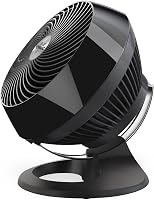
The Vornado 630 is a medium air circulator with a 9-inch blade and three-speed manual controls. Its adjustable tilt head lets you aim the airflow where you sit.
For a bedroom or home office, it's a sensible low-power choice that still moves air through the room.
The Lasko Wind Machine 3301 is the big-air option. Its 20-inch blade and 2000 cfm airflow rating make it suited to garages, workshops and large rooms.
Its pivoting head gives 360° directional airflow. If you need to cool a large space fast, this fan does it, and its top speed is the setting that draws the most power.
The Shark TurboBlade is a bladeless tower fan with 10 speeds and up to 180° oscillation. More speed steps let you pick a setting just strong enough for comfort rather than jumping from low to high.
Its bladeless design is also easy to wipe clean. For a living room where you want quiet, adjustable airflow, this is the pick.
When you're ready to shop, our roundup of the best floor fans for home cooling compares the leading models by room size and features.
Can you lower your fan's electricity cost?
Yes, with four simple habits: run it only when needed, use the lowest effective speed, aim it at people and keep the blades clean. Together these cut both hours and watts.
Clean blades move air more efficiently. Dust and lint on the blades and grill make the motor work harder for the same breeze.
Our guide to how to clean a floor fan shows the safe way to take one apart and wipe it down.
Aim matters as much as speed. Point the fan at the person, not the wall.
Oscillation spreads air but spends more time pointing away from you. For one person, a fixed aim on low can feel as good as a wide sweep on high.
Use fans alongside open windows at night or with the AC on a higher setting. Shut the fan off when the room is empty.
These small choices keep the cost of running a floor fan close to a few dollars a month.
How does a floor fan compare with a tower fan on electricity?
Both draw similar power for the air they move, so the choice comes down to room fit, not watts. A tower fan and a floor fan of similar airflow use roughly the same electricity.
A tower fan stands tall and narrow, so it fits tight spots and often has more speed settings. A floor fan like the 20-inch Lasko moves more air per minute and suits big rooms.
Our guide to how much electricity a tower fan uses breaks down its typical draw the same way.
Pick by the space. A tower fan for a bedroom corner or a narrow hallway.
A floor fan for a garage, workshop or large living area. Either way, the running cost is small, and the biggest savings come from using it less and cleaning it regularly.
Frequently asked questions
Is a floor fan cheaper to run than air conditioning?
Yes. A floor fan uses a small fraction of the power a central air conditioner draws.
Fans cool people by moving air over skin, though, so they work best in a room that is already comfortable or with windows open at night.
Does a floor fan use power when it is switched off?
Usually very little. Most floor fans have a simple mechanical dial or button and draw no meaningful standby power.
A fan with a remote or digital display may draw a small trickle, so unplug it if you want to be sure.
Will running a floor fan all night raise my bill a lot?
Not much. Eight hours on high at 100 watts is about 0.8 kWh, or around 13 cents at 16 cents per kWh.
A whole month of nightly use lands near four dollars, far less than most other appliances in the home.
Does fan speed change electricity use?
Yes, clearly. Lower speeds draw less power, and the drop is often more than proportional.
Running a fan on low or medium for most of the day saves money and is usually quiet enough for sleep or work.
Can a fan make a room colder?
No. A fan moves air but does not lower the temperature of the room.
It helps you feel cooler by speeding evaporation on your skin and by pushing air toward you, so it pays to aim it at people, not at empty space.