How Much Power Does a Pedestal Fan Use?
A typical pedestal fan draws about 40 to 60 watts on its highest speed. The Amazon Basics 16 inch model states 60 watts, so running it for 8 hours costs roughly 14 cents at the US average electricity rate.
On this page (9 sections)
- How many watts does a pedestal fan use?
- How much does it cost to run a pedestal fan?
- What changes how much power a pedestal fan uses?
- Which pedestal fans use less power?
- Do fan speed settings really change the watts used?
- Is a pedestal fan cheaper than air conditioning?
- Can you run a pedestal fan on solar or battery power?
- How do you keep a pedestal fan's power use low?
- Which pedestal fan should you pick for low power use?
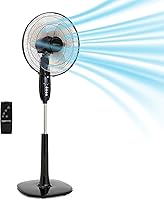
A typical pedestal fan draws about 40 to 60 watts on its highest speed. The Amazon Basics 16" Pedestal Fan with Remote states 60 watts, so running it 8 hours a day uses about half a kilowatt-hour of electricity.
That's a fraction of what an air conditioner draws, which is why a fan is the cheapest way to move air on a hot day.
The exact number depends on the fan's motor and speed setting. A small DC fan can run below 40 watts, while a large AC fan on high can edge toward 70.
The rest of this guide breaks down how much power a pedestal fan uses, what changes the draw, and how to keep the running cost low.
How many watts does a pedestal fan use?
Most pedestal fans run between 40 and 60 watts on high speed. A 16 inch fan with a standard AC motor, like the Amazon Basics model, is rated at 60 watts.
A 20 inch fan or a model with a stronger motor may draw a bit more, while a compact DC fan draws less.
Wattage is the number that matters for your bill. To find a fan's wattage, look at the label on the motor housing or the sticker on the base.
The number is printed as watts or W, next to volts and amps. If you only see amps, multiply amps by 120 volts to get watts.
That puts a pedestal fan in the same power range as a ceiling fan or a box fan. It's far below a space heater, which often runs 1,000 to 1,500 watts.
Our guide to how much electricity a floor fan uses covers the same math for floor fans.
How much does it cost to run a pedestal fan?
A pedestal fan costs roughly 1 cent an hour at the US average electricity rate. The math is simple: watts times hours, divided by 1,000 to get kilowatt-hours, then multiplied by your rate.
At 50 watts and a rate of about 17 cents per kWh, one hour costs under a cent to 1 cent.
Over a month, 8 hours of daily use at 50 watts adds up to about 12 kWh. At the same rate, that's around 2 to 3 dollars a month depending on where you live.
A 60-watt fan running the same hours costs a little more, and a 40-watt fan costs a little less.
Your actual rate decides the real number. Check your electric bill for the price per kWh, then use the formula above.
The difference between a 40-watt and a 60-watt fan over a month is only a few dollars.
What changes how much power a pedestal fan uses?
The speed setting matters most, followed by motor type and fan size. A fan on low speed may draw about half the watts it uses on high.
Higher speeds spin the motor faster and push more air, so they pull more current from the outlet.
Fan size comes next. A 20 inch fan moves more air per minute than a 16 inch fan, but the bigger blade and motor usually draw more watts to do it.
A 16 inch fan is the common middle ground for bedrooms and living rooms.
Motor type makes a real difference. An AC motor fan like the Amazon Basics model is rated at 60 watts.
A brushless DC motor fan, like the DREO TurboPoly Fan 512, is built to move air with less power. DC motors are more efficient at low and medium speeds, which suits all-night bedroom use.
Which pedestal fans use less power?
DC motor fans generally use less power than AC fans for the same airflow. The DREO model is the DC option among our picks, and its motor is the main reason.
It's also the quietest at low speeds, which fits a bedroom or a home office.
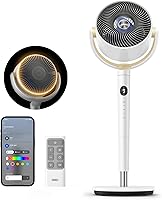
The DREO 100ft Airflow DC Pedestal Fan has 9 speeds and 4 modes. Its brushless DC motor is designed to circulate air quietly, and the fan reaches as far as 100 ft according to DREO.
That's more coverage than a typical 16 inch AC fan gives.
If you want the lowest draw and quiet operation, a DC fan is the better buy. If you just need strong airflow in a big room and don't mind a few extra watts, an AC fan does the job for less money upfront.
Compare both in our roundup of the best floor fans.
Do fan speed settings really change the watts used?
Yes. A pedestal fan on low draws noticeably less than the same fan on high.
The motor turns slower, so it pulls less current.
The exact split varies by model, but many fans use about half the watts on low that they use on high.
That matters for how you run the fan. If you leave a fan on all day for background air movement, low or medium speed saves a little electricity and keeps the noise down.
Reserve high speed for the hottest part of the afternoon or when you're drying a room.
A remote and a timer help here. The Amazon Basics fan has 3 speeds and 3 modes, including a sleep mode.
Setting it to sleep mode or a timer means the fan drops to a lower draw instead of running flat out all night.
Is a pedestal fan cheaper than air conditioning?
A pedestal fan uses far less power than an air conditioner. A typical window AC unit draws 500 to 1,500 watts, while a pedestal fan draws about 40 to 60 watts.
That's roughly 10 to 30 times less electricity for the fan.
The trade-off is what each one does. An air conditioner lowers the room temperature, while a fan moves air across your skin so you feel cooler.
A fan works best when the air is already cool or when you're sitting in its breeze.
For many homes, the smart move is to run the AC less and use a fan to keep air moving. A pedestal fan in the living room or bedroom can let you set the thermostat a few degrees higher without feeling stuffy.
See the best standing fans for living rooms for models that cover a whole seating area.
Can you run a pedestal fan on solar or battery power?
Yes. At 40 to 60 watts, a pedestal fan is easy to run on a portable power station or a small solar setup.
It draws far less than a heater or a microwave, so a modest battery can keep it going for hours.
Runtime depends on the battery's capacity in watt-hours. A 500 Wh station running a 50-watt fan would last about 10 hours in theory, though real runtime is shorter after conversion losses.
A 1,000 Wh station roughly doubles that.
This makes a pedestal fan a good backup cooling option during an outage. It's also a light load for an off-grid cabin or a van setup.
Keep the fan's wattage in mind when sizing the battery, and run it on low speed to stretch the runtime.
How do you keep a pedestal fan's power use low?
Run it on the lowest speed that keeps you comfortable, and use the timer or sleep mode. These two habits cut the most electricity without changing how the fan feels.
Most people don't need high speed for everyday cooling.
Keep the fan clean, too. Dust on the blades and grill makes the motor work harder to move the same air.
Wipe the blades and vacuum the grill a few times a season so airflow stays strong at lower speeds.
Place the fan where it helps most. A fan aimed at the people in the room cools better than one blowing into an empty corner.
That lets you run a lower speed and still feel the breeze.
Which pedestal fan should you pick for low power use?
Pick a DC motor fan if low power and quiet running matter most. The DREO 100ft Airflow DC Pedestal Fan is the efficient pick here, with a brushless DC motor, 9 speeds, and quiet low-speed operation.
Its 120 degree oscillation and tilt help you aim the breeze where you sit.
The Amazon Basics 16" Pedestal Fan with Remote is the straightforward AC choice. It's rated at 60 watts, has 3 speeds and 3 modes, a remote, and a timer, and it covers medium to large rooms.
For most people who want a simple, affordable fan, it's the easy pick.
The Lasko Cyclone 1843 Oscillating Pedestal Fan is the tall, adjustable option. Its stand extends to 54 inches, and it has three quiet speeds, a remote, and a 4-hour timer.
If you want airflow aimed high across a room, the extra height helps.
Whichever fan you choose, the answer to how much power a pedestal fan uses stays modest. Expect about 40 to 60 watts on high and less on low.
Run it on the lowest speed that works, use the timer, and keep the blades clean. That keeps the cost to a few dollars a month and lets you lean on the fan instead of the air conditioner.
Frequently asked questions
Does a pedestal fan use more power on high speed?
Yes. Higher speed settings spin the motor faster and draw more watts, so a fan on high uses more electricity than the same fan on low.
The difference is small in dollars, but a lower setting for everyday cooling saves a little without losing much airflow.
Is it cheaper to run a pedestal fan all night?
It's inexpensive but not free. At roughly 50 watts, 8 hours of overnight running costs about 7 to 8 cents at the US average rate.
A timer or a lower speed setting trims that further if you only need airflow to fall asleep.
Does a DC pedestal fan use less power than an AC one?
A DC motor fan usually draws less power for the same airflow than an AC motor fan. The DREO TurboPoly Fan 512 uses a brushless DC motor.
Check the wattage on the fan you're considering, since wattage matters more than motor type alone.
Can a pedestal fan run on a portable power station?
Yes. At about 40 to 60 watts, a pedestal fan draws far less than a heater or air conditioner.
Most portable power stations handle that load easily, though runtime depends on the station's capacity and how high you run the fan.
What does a pedestal fan cost to run per month?
At about 50 watts and 8 hours a day, a pedestal fan uses roughly 12 kWh a month, or about 2 to 3 dollars at the US average rate. Running it fewer hours or on a lower speed cuts that cost.