How Does a Box Fan Work?
A box fan works by spinning five angled blades inside a square housing, pulling room air in through the back grille and pushing it out the front. The motor converts electricity into rotation, and the housing guides the airflow into a straight, focused stream.
On this page (9 sections)
- How does a box fan move air?
- What do the motor, blades and housing each do?
- How do the speed settings change the airflow?
- Why does moving air feel cool on your skin?
- Where should you place a box fan for the best results?
- How do you clean a box fan so it keeps working well?
- What size box fan should you buy?
- How does a box fan work compared with other fan types?
- What should you know before you buy one?
A box fan works by spinning five angled blades inside a square housing, pulling room air in through the back grille and pushing it out the front. The motor turns electricity into rotation, and the housing guides the airflow into a straight, focused stream.
That simple design is why box fans are cheap, light and easy to move from room to room. Here's what happens inside when you turn one on, and how to get the most out of it.
How does a box fan move air?
The motor spins the blades, and the angled blade shape pushes air forward. As each blade turns, it scoops air from behind the fan and throws it toward the front grille.
The square housing matters here. A round fan sends air outward in a spreading cone, but a box fan's flat sides keep the stream roughly straight.
That straight push is why a box fan works well for moving air from one place to another, such as out a window or down a hallway.
The front grille also shapes the flow. Its slots straighten the air slightly as it leaves, so the breeze stays more focused than it would with no grille at all.
The result is a wide but fairly directed column of moving air.
What do the motor, blades and housing each do?
The motor provides the power, the blades create the push, and the housing directs it. Each part has a clear job, and the design trades some refinement for simplicity.
The motor is usually a small electric motor rated in watts. The Amazon Basics model runs at 67 watts, for example.
A higher wattage generally means more air movement, but it also means more electricity used and more noise.
The blades are plastic on most box fans. Five blades is common, and the pitch of each blade determines how much air it grabs per turn.
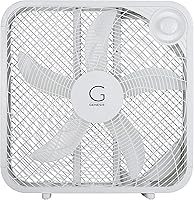
The Amazon Basics fan and the Genesis 20" both use five blades.
The housing is the square frame plus the front and back grilles. It protects the blades, keeps fingers out, and holds the whole unit steady.
Extra-large feet, like the ones on the Amazon Basics fan, help stop wobble on smooth floors.
How do the speed settings change the airflow?
Each speed setting changes the motor's rotation speed, which changes how much air the fan moves. Low speed turns slowly for a gentle breeze, while high speed spins fast for maximum push.
Most box fans offer three settings. The Amazon Basics 3-Speed Box Fan has low, medium and high, controlled by a knob.
The Genesis 20" Box Fan also has three settings. The Vornado Model 80 steps up to five speeds, which gives you finer control between a light breeze and a strong gust.
Higher speed means more noise. If you need a fan for sleep, the low or medium setting usually keeps the airflow useful while staying quieter.
For pushing air out a window on a hot afternoon, the top speed does the most work.
Some fans also have a thermostat or timer. Those features let the fan cycle on and off on its own, but the basic airflow job stays the same.
Why does moving air feel cool on your skin?
Moving air speeds up evaporation of moisture on your skin, and that makes you feel cooler. The fan doesn't chill the air itself; it changes how your body sheds heat.
When air sits still, a thin layer of warm, moist air stays close to your skin. A fan blows that layer away and replaces it with drier room air.
Sweat evaporates faster, and evaporation pulls heat away from your body.
That's why a box fan feels good even when the room thermometer hasn't moved. It's also why the effect fades in very humid air: when the air is already full of moisture, sweat evaporates more slowly.
Our guide to how to cool a room with a fan covers placement tricks that make the most of this effect.
Where should you place a box fan for the best results?
Point the fan at you for personal comfort, or face it out a window to exhaust hot air. Placement decides whether the fan cools a person or helps clear a room.
For personal cooling, set the fan a few feet away and aim the stream at your body, not just your face. A slight angle across the room feels better than a direct blast, and it moves more air around you.
For room cooling, put the fan in an open window facing outward. It pushes hot indoor air outside, and fresh air comes in through another open window.
A box fan for window use needs a snug fit so the exhaust doesn't leak back around the frame.
Keep the fan on a flat surface and away from curtains, bedding and loose paper. The intake at the back needs clear space to pull air in.
Which box fan suits a small bedroom?
The Amazon Basics 3-Speed Box Fan for Bedroom is the pick for a small bedroom because it's light and easy to move at 5.8 lb, with a carry handle on top and extra-large feet that keep it steady.
Its 20-inch frame and 67-watt motor give it enough push for a bedroom without taking much floor space. The knob control is simple to use in the dark, and the three speeds cover both a light night breeze and stronger daytime airflow.
Which box fan suits whole-room circulation?
The Vornado Model 80 High Velocity Box Fan is the pick when you want to move air through a whole room, thanks to its five speeds and its focus on circulation.
The removable grille makes cleaning easier, since you can take it off and wipe away dust. It's heavier at 13.5 lb, so it suits a spot where it can stay put rather than a fan you carry around daily.
Which box fan suits budget cooling?
The Genesis 20" Box Fan is the pick for straightforward cooling on a budget, with three speeds and a copper motor the brand says is built for long-lasting performance.
It rests on any flat surface and has a plain white look that fits most rooms. The three settings keep operation simple, and the fuse in the plug adds a layer of overload protection.
How do you clean a box fan so it keeps working well?
Unplug the fan, then wipe the grilles and blades to clear dust. Dust is the main reason a box fan slowly loses its push.
Start by unplugging the fan and letting the blades stop fully. Wipe the front and back grilles with a damp cloth or a vacuum brush.
If the grille comes off, like on the Vornado Model 80, take it off and wash it in the sink, then dry it completely.
Reach between the grille slots with a soft brush or a cloth wrapped around a pencil to clean the blade edges. Don't spray cleaner into the motor housing.
Let every part dry before plugging the fan back in.
Clean a box fan once or twice a season, or more often if it runs daily in a dusty room. A clean fan moves more air at the same speed setting and runs with less strain.
What size box fan should you buy?
A 20-inch box fan is the standard size for most rooms, and it balances airflow with floor space. Smaller fans take up less room but move less air.
A 20-inch fan like the Genesis or the Amazon Basics model fits in most bedrooms and living rooms without blocking a walkway. It's light enough to move, and its wide face pushes a broad stream of air.
Measure the spot where the fan will sit and the window if you plan to use it there. Our guide to what size fan do I need for my room walks through matching fan size to room size.
Also think about the type. A box fan pushes a straight stream.
An oscillating fan sweeps side to side, which spreads air around a room but gives a less focused push. Box fans win for window exhaust and directed airflow.
How does a box fan work compared with other fan types?
A box fan trades some quietness and spread for a strong, straight push. Tower and pedestal fans often run quieter and spread air wider, but a box fan is usually cheaper and easier to aim.
Box fans are also the easiest type to fit in a window for exhaust. Their square shape fills the opening better than a round fan, so less hot air slips back around the edges.
That makes them a practical choice on hot afternoons.
The trade-off is noise. A box fan on high is louder than most tower fans at a similar airflow.
If quiet operation matters most, a tower fan may suit you better; if raw air movement and window use matter more, a box fan is the simpler tool.
What should you know before you buy one?
Match the fan to how you'll use it: personal cooling, window exhaust or whole-room circulation. Then check weight, speed settings and cleaning access.
For a bedroom you carry around, a light fan with a handle and three speeds covers the basics. For a larger space or a window, a heavier fan with more speeds and a removable grille gives you more control.
For a simple budget setup, a plain three-speed 20-inch fan does the job.
Once you know how a box fan works, the buying decision gets easier: pick the airflow and the footprint that fit your room. Clean it regularly, aim it where it helps, and it will keep moving air for years.
Frequently asked questions
Does a box fan actually cool the air?
No, it doesn't lower the room temperature. A box fan moves air across your skin, which speeds up evaporation and makes you feel cooler, and it can push hot air out of a room when placed in a window.
Is it safe to leave a box fan running all night?
Yes, a box fan is designed for continuous use. Keep it on a flat, stable surface away from curtains and loose items, and check that the cord and plug stay dry and undamaged.
Why does my box fan feel weaker than it used to?
Dust on the blades and grille is the most common cause. Unplug the fan, wipe the blades and grille, and let it dry fully before running it again to restore airflow.
Can a box fan be used in a window to exhaust hot air?
Yes. Face the fan outward so it blows hot room air outside, and open a window on the opposite side of the room to let fresh air in.
A snug fit in the window frame makes the exhaust more effective.